

March 2022 ARVIC
The March 2022 ARVIC conference focused on building disciplined, context-aware ad testing frameworks that prioritize normative benchmarking and ongoing measurement over single-score evaluations.
The March 2022 ARVIC session centered on the practical mechanics of creative and ad evaluation. The core argument running through the conference: a single metric or a single test tells you very little. What matters is a consistent process, a growing benchmark database, and enough contextual awareness to interpret what any given score actually means.
Norms and Context Over Isolated Scores
A recurring emphasis was the danger of reading ad scores in isolation. Without normative context, even a strong result can mislead. The guidance was direct: stand up a standardized testing process first, accumulate benchmarks over time, and only then draw firm conclusions from individual tests.
- Build a normative database before treating any single score as actionable.
- Context shapes results. A fitness brand ad tested at New Year's will produce inflated consideration and intent scores compared to the same ad tested two months later.
- Start simple. Layer in custom audiences, custom norms, and custom brand questions as your process matures.
What Creative Can and Cannot Move
Not all metrics respond equally to creative execution. The session drew a clear line between two groups of measures.
- Recall, likability, engagement, and viral potential are more directly influenced by the creative itself.
- Consideration, intent, and recommendation are harder for any single ad to move and are shaped more by category dynamics than by execution.
- Brand recall is table stakes. Engaging creative that fails to build brand association is a problem, regardless of how well it scores on other dimensions.
Dial Testing as a Diagnostic Tool
Dial testing was positioned not as a pass/fail gate but as a scene-level diagnostic. Its value lies in pinpointing which specific moments in a spot are driving positive or negative reactions, making it especially useful when editing a long-form piece down to a shorter cut. Used that way, it informs decisions rather than making them.
Presentations
 01
01Anatomy of a Creative Test: A Practical Framework for Ad Evaluation
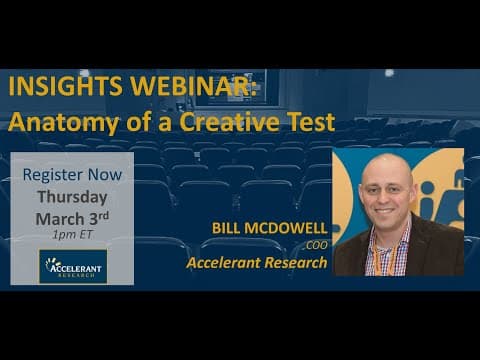
Bill McDowell, CEO of Accelerant Research, walks through the company's framework for creative and ad testing, covering KPI scorecards, normative databases, and dial testing. Using publicly available ads tested on Accelerant's own panel, he illustrates what strong and weak performance looks like across the funnel, and explains why context, norms, and ongoing measurement discipline matter more than any single score.
Watch the talkWant to be in the room next time?
Register for next conferenceRelated conferences
April 2022 ARVIC
The April 2022 ARVIC conference brought together research and product practitioners to examine inclusive design principles, distributed team cohesion, and methodological rigor in survey fielding.
ViewJune 2, 2022June 2022 ARVIC
The June 2022 ARVIC conference focused on rigorous, practical pricing research, offering researchers and product teams a clear framework for choosing and executing the right methodology.
ViewOctober 28, 2021October 2021 ARVIC
The October 2021 ARVIC conference focused on making research more durable and trustworthy by building shared ownership, protecting vulnerable participants, and turning qualitative data into concrete, reusable models.
ViewPresent at the next ARVIC
Share a method, a study, or a hard-won lesson with a room of senior research practitioners.