

August 2026 ARVIC
The August 2026 ARVIC conference focused on the fundamentals of rigorous research practice, covering how to eliminate bias from study design and how structured process discipline turns raw data into actionable business decisions.
The August 2026 ARVIC virtual conference brought together practitioners to address two persistent problems in market research: the cognitive traps that compromise objectivity, and the process gaps that prevent good data from becoming good decisions. Across both sessions, a single thread ran through the content: the quality of research output is determined long before a single respondent is recruited or a single data point is collected.
Bias Is a Design Problem, Not Just a Human One
One session examined confirmation bias and its adjacent fallacies in depth, tracing how they enter research at every stage from initial framing to stakeholder presentation. The core argument is that bias is structural, not accidental. It lives in the hypotheses researchers never write down, the sampling decisions that go unchallenged, and the survey options that are never offered to respondents.
- State your hypothesis explicitly before every study. Making assumptions visible is the first step to challenging them.
- Treat every study as a test of a hypothesis, not a proof of one. Look for evidence on both sides.
- Audit sampling decisions early. An unchallenged age cutoff in a CPG study, for example, can hide a segment that represents a meaningful share of category consumption.
- Build survey answer options that reflect the full range of real motivations. A question that only offers health-related options will overstate health as a driver.
- Do not assume AI corrects for bias. Models can magnify errors in training data, produce outputs that exclude groups, and do so inside a black box that is difficult to audit.
- Use projective and observational methods, such as image elicitation, shop-alongs, and storytelling, to surface the habitual and emotional drivers that direct questioning tends to suppress.
Process Rigor Determines Research Value
A second session offered a seven-stage framework for research project management, from objective-setting through executive presentation. The central point is that the decisions made before any data is collected determine how useful the final output will be. A signed-off research brief, a structured stakeholder interview, and a clear three-layer objective framework are not administrative formalities; they are the mechanisms that connect research to real business decisions.
- Anchor every project to three layers: business goal, research objectives, and measurable success criteria. Research without a clear link to a business decision risks producing output no one acts on.
- Conduct a structured stakeholder interview before selecting a methodology. When speed and quality are in conflict, document the tradeoff explicitly rather than leaving it implicit.
- Write the research brief after the methodology is chosen, so stakeholders approve a complete and concrete plan. Treat it as a binding contract against scope creep.
- Complete secondary research before primary data collection to set context and identify genuine gaps.
- When data contradicts itself, report it transparently. Behavioral findings generally carry more weight than self-reported answers, and contradictions can be reframed as productive tension for the business.
- Tailor every deliverable to its audience. Lead executives with the conclusion, limit slide decks to roughly ten slides, and move methodology detail to the appendix.
The Broader Signal
Taken together, the sessions make a consistent case: research fails not because practitioners lack analytical skill, but because the conditions for rigorous work are not built into the process from the start. The practical steps offered across both talks are straightforward to adopt and apply across CPG, healthcare, qualitative, and quantitative contexts alike. The challenge for insights teams is treating them as standard operating procedure rather than best-case aspirations.
Presentations
 01
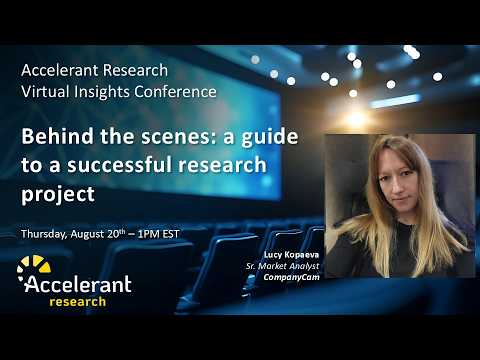
01Behind the scenes: a guide to a successful research project
Lucy, a senior market analyst at Company CAM, walks through a seven-stage framework for running a research project from objective-setting to executive presentation. The talk emphasizes that rigorous process work before any data is collected, including stakeholder interviews, methodology selection, and a signed-off research brief, determines the quality and usefulness of the final output. Practical advice on data analysis, report writing, and audience-tailored presentation rounds out the session.
Watch the talk
Want to be in the room next time?
Register for next conferenceRelated conferences
June 2026 ARVIC
The June 2026 ARVIC conference challenged insights professionals to move beyond reactive habits, treating fraud, personalization, ethics, and AI as interconnected forces that demand proactive, human-centered strategy.
ViewApril 23, 2026April 2026 ARVIC
The April 2026 ARVIC conference challenged insights professionals to move beyond generating reports and toward driving decisions, cultural change, and lasting organizational impact.
ViewPresent at the next ARVIC
Share a method, a study, or a hard-won lesson with a room of senior research practitioners.