

June 2026 ARVIC
The June 2026 ARVIC conference challenged insights professionals to move beyond reactive habits, treating fraud, personalization, ethics, and AI as interconnected forces that demand proactive, human-centered strategy.
- 01Beyond Research: How AI Is Transforming Insights into Decision Engines
- 02Hyperpersonalization: Tailored Experiences in the Age of AI
- 03The Price of Insight: The Overlooked Realities of Conducting Research in Vulnerable Communities
- 04Think Like a Fraudster: The Blind Spot in the Industry Fraud Conversation
The June 2026 ARVIC conference brought together researchers, UX leaders, and insights strategists to examine the pressures reshaping market research practice. Across four talks, a consistent tension emerged: the industry's default responses to its biggest challenges, whether fraud, AI adoption, personalization, or data production, are structurally behind the curve. Speakers pushed practitioners to replace panic and report-generation habits with systems thinking, ethical rigor, and a clearer sense of where human judgment is irreplaceable.
Rethinking Fraud: From Emotional Reaction to Business-Model Thinking
One talk reframed online survey fraud as a scaled, profit-driven enterprise with its own R&D, distribution, and marketing functions. The practical implication is that reactive strategies are structurally insufficient because the industry narrative on specific fraud techniques typically runs six to nine months behind fraudsters' actual development cycles.
- A scan of 136,000 fraudster marketplace messages found fewer than 0.5% related to AI or synthetic respondent techniques, suggesting the current industry fixation on AI bots may not reflect where fraud is actually scaling.
- Friction is a defensive asset: complexity across panels, tools, and agency approaches raises costs for attackers and accelerates exploit abandonment.
- Data quality and fraud are not synonyms. Respondent disengagement and poor survey design produce bad data that can look like fraud but requires a different response.
- A holistic, systems-based approach covering pre-survey, in-survey, and post-survey phases outperforms stacking device-fraud checkers or relying on any single vendor score.
AI as Accelerator: Powerful but Bounded by Human Judgment
Two talks converged on a clear-eyed view of what AI can and cannot do inside research and insights workflows. In hospitality UX, AI was credited for removing noise, identifying correlations, and accelerating experimentation, but found to fall short when cultural nuance, social norms, or complex human context are involved. In the insights-as-decision-engine model, AI was shown to accelerate every stage of the process while prioritizing, activating, and measuring outcomes still required human judgment, domain knowledge, and stakeholder context.
- The core shift for insights teams is from answering 'what happened?' to answering 'what should we do?' Teams that stay in report-generation mode risk being replaced by AI.
- Information scarcity is no longer the bottleneck. Decision confidence is, and that is where insights professionals must add value.
- A five-stage decision-engine model was proposed: discover signals, understand context, evaluate options, activate strategy, and measure outcomes. Most insights teams drop off after stage two or three.
- Before acting on any AI-generated insight, teams should have a clear plan covering when humans intervene, how frequently to target, what will offend, and how much to trust the data.
Personalization at Scale: Restraint as a Competitive Advantage
A dedicated talk on hyperpersonalization in hospitality offered a cautionary frame for any team using behavioral data and AI to tailor experiences. The most effective personalization was described as proactive, predictive, and genuinely contextualized rather than simply data-driven targeting. Critically, over-personalization creates filter bubbles, erodes trust, and produces a hedonistic satisfaction that dulls engagement over time.
- Service blueprints have replaced journey maps in one major hospitality context because they better capture the full complexity of multi-person, multi-stage behavior.
- Small personalized nudges should be designed to shift habits gradually, not just drive a single transaction.
- Restraint and subtlety were positioned as competitive advantages in high-trust, emotion-driven industries.
Ethics and Context: The Hidden Cost of Insight Production
One talk stood apart in its focus on the ethical and human stakes of qualitative research in vulnerable communities. Using a direct case example, the speaker argued that trust, context, and ethics are not preconditions for research but are the research itself. This is a direct challenge to any move toward scaled or AI-mediated methods in high-stakes environments.
- Trust operates across four layers: participant disclosure, institutional perception, interpretation, and reporting fidelity. Each layer affects the next.
- Context is not background information. It is the operating system the data runs on, actively producing every response.
- Silence, hesitation, and the decision to continue a session after an emotional moment are data points no discussion guide question would reach.
- Removing the human element from high-stakes qualitative research risks losing the most meaningful signals entirely.
Cross-Conference Themes to Carry Forward
- Proactive, systems-level thinking beats reactive, single-point solutions across fraud defense, AI adoption, and insights strategy alike.
- Human judgment remains the critical center in every domain discussed, not as a limitation of AI but as a deliberate, value-creating choice.
- Stakeholder communication is itself a research deliverable. Tailoring findings to the specific tensions and priorities of each audience was raised as essential by multiple speakers.
- Reading broadly outside your research domain, including market trends, competitor activity, and macroeconomic signals, was recommended for giving stakeholders a fuller picture than research data alone can provide.
Presentations
 01
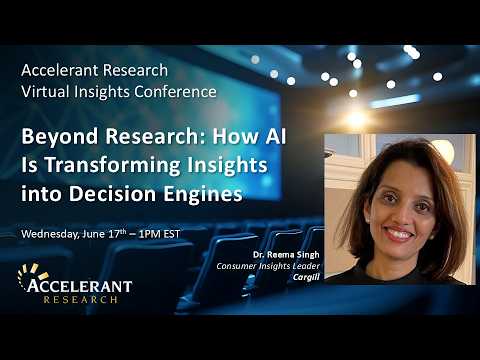
01Beyond Research: How AI Is Transforming Insights into Decision Engines
Dr. Rima Singh, Consumer Insights Lead for Cargill's Animal Nutrition and Health business, argues that the insights function must evolve from producing research reports to becoming a "decision engine" that helps organizations make better decisions. She walks through a four-stage operating model, illustrates it with a pet nutrition example, and explains how AI accelerates each stage while human judgment remains the critical center. The talk is grounded in her own day-to-day practice and is aimed at helping insights professionals stay relevant as AI commoditizes data generation.
Watch the talk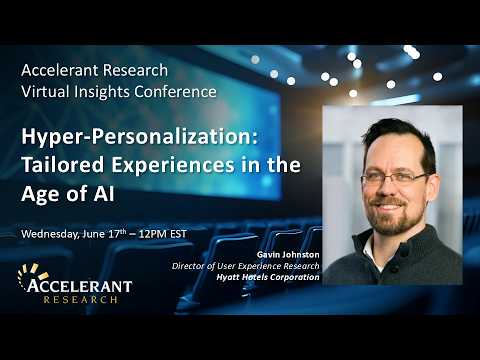 02
02Hyperpersonalization: Tailored Experiences in the Age of AI
Gavin Johnston, Director of UX Research at Hyatt Hotels, walks through how Hyatt approaches hyperpersonalization using a combination of AI, behavioral data, and qualitative research grounded in context, culture, and linguistics. He outlines practical frameworks for building tailored guest experiences while calling out the real risks of filter bubbles, trust erosion, and "creepiness" from over-targeting. The talk emphasizes that AI is a powerful tool but requires human judgment, especially in high-trust, emotion-driven industries like hospitality.
Watch 03
03The Price of Insight: The Overlooked Realities of Conducting Research in Vulnerable Communities
Carrie Dugan, a user researcher, argues that insight produced in high-stakes research environments is never neutral. Drawing on a session with a 30-year-old cancer patient in Puerto Rico, she shows how trust, context, and ethics are not preconditions for research but are the research itself. She challenges practitioners to recognize who pays the real cost of the insight they produce and to carry findings in a way that honors the conditions that made them possible.
Watch 04
04Think Like a Fraudster: The Blind Spot in the Industry Fraud Conversation
Terrence McCarron, CEO and founder of Opinion Route, argues that the market research industry's fraud conversation is dominated by emotion and individual stakeholder panic rather than a clear-eyed understanding of how fraud actually operates as a scaled, profit-driven enterprise. He introduces the concept of "Fraud, Inc." to reframe the threat and offers four concrete truths to help researchers build confidence and move from reactive to proactive data quality strategy. The talk also covers Opinion Route's methodology, including ethical hacking, white-hat hiring, red teaming, and marketplace surveillance, to quantify real fraud risks and separate hype from reality.
WatchWant to be in the room next time?
Register for next conferenceRelated conferences
April 2026 ARVIC
The April 2026 ARVIC conference challenged insights professionals to move beyond generating reports and toward driving decisions, cultural change, and lasting organizational impact.
ViewAugust 20, 2026August 2026 ARVIC
The August 2026 ARVIC conference focused on the fundamentals of rigorous research practice, covering how to eliminate bias from study design and how structured process discipline turns raw data into actionable business decisions.
ViewMarch 26, 2026March 2026 ARVIC
The March 2026 ARVIC conference examined how AI is reshaping research and design practice, pressing the field to sharpen human judgment, defend data quality, and bridge disciplines before standards catch up.
ViewPresent at the next ARVIC
Share a method, a study, or a hard-won lesson with a room of senior research practitioners.