

July 2021 ARVIC
The July 2021 ARVIC conference brought together practitioners and academics to tackle how research teams can move faster, scale wider, and stay credible in a rapidly changing environment.
- 01Adapting Traditional Market Research to an Agile Toolkit: A Journey at Lincoln Financial Group
- 02Best Practices for Using Crowdsourcing Platforms in Survey Research: The Case of Amazon Mechanical Turk
- 03Beyond 2020: How Young People Around the World Are Thinking About the Future
- 04Democratizing Research Without Jeopardizing Your Job
The July 2021 ARVIC conference covered a range of challenges facing modern insights teams: how to scale research without scaling headcount, how to maintain data quality in crowdsourced environments, how to meet the speed demands of agile organizations, and what a new generation of consumers expects from the world and from brands. Across all four sessions, a common thread emerged: rigor and speed are not opposites, and the researchers doing the best work are the ones who have made deliberate choices about where to flex and where to hold firm.
Scaling Research With Limited Resources
Two sessions addressed the practical problem of doing more with less, approaching it from different angles: one focused on headcount and organizational reach, the other on budget and decision-making speed.
- Find internal allies first. Colleagues already asking good questions are a more productive starting point than trying to convert the whole organization at once.
- Delegate low-risk tasks, such as surveys, polls, and guerrilla testing, with written guidelines so quality standards remain yours even when others do the work.
- A public research repository with sourced data, sample details, and documented recommendations prevents findings from being misquoted or misapplied downstream.
- Agile platforms work best for short, focused studies of three to five questions. Treating them as a replacement for complex surveys undermines the speed advantage they offer.
- Unlimited-capacity platform licenses remove budget approval as a bottleneck, which is often what keeps insights out of early-stage decisions.
- A deliberate team checkpoint at twelve to eighteen months helps identify where old research habits are slowing down an agile workflow.
Data Quality in Crowdsourced Research
One session offered a grounded look at crowdsourcing platforms as a cost-effective data collection method, with a clear-eyed accounting of their risks. The practical guidance here is useful for any team considering platforms like Amazon Mechanical Turk for general-population work.
- Crowdsourcing is well suited to general-population studies such as consumer behavior and online shopping. It is a poor fit for specialized or niche samples.
- Plan to collect roughly 30 percent more responses than your target, since cleaning for bots, speeders, and inconsistent answers typically removes about that share.
- Cross-validate respondent identity by asking the same demographic question in two different formats at different points in the survey, then flag conflicting records.
- Use dynamic, randomized completion codes rather than a static code to prevent sharing and reuse by bad actors.
- Pilot with a small batch first to calibrate actual completion time, then set payment based on a fair hourly rate. Underpaying reduces quality; overpaying is unnecessary.
What Young Consumers Want Next
One session presented findings from a global survey of over 8,000 people aged 16 to 24 across 15 countries, examining how the events of 2020 reshaped this generation's expectations. The data carries direct implications for brand strategy and product positioning.
- Happiness among 16 to 24 year olds fell from roughly 70% to just over 50% between 2012 and 2020, while stress rose from 36% to 46%. These are structural shifts, not short-term fluctuations.
- Despite widespread pessimism about the world, over 90% of young people say they want to make the most of what comes next and acknowledge they will have to work hard to get there.
- Young people globally ranked the environment and climate change as the top societal priority for the next decade, even in a year dominated by COVID-19. The US was a notable exception.
- For their own lives, top priorities center on security: a stable job, keeping loved ones safe, mental health, and a strong family unit.
- 83% of young people already expect brands to stand up against social injustice, and nearly 80% expect that expectation to grow. Authenticity matters: they will hold brands accountable when actions contradict messaging.
- Brands can respond concretely by making genuine long-term commitments, giving young people tools and spaces to act, and telling stories of resilience and cultural diversity.
The Rigor-Speed Trade-Off
A theme running across multiple sessions is that the choice between rigor and speed is often false, but only if teams make deliberate decisions upfront about what level of certainty a given decision actually requires. Agile tools are best used to earn a seat at early-stage conversations and surface language and concept issues before a full custom study is warranted, not to replace robust research when the stakes are high. Similarly, democratizing research within an organization is not about lowering the bar; it is about extending the reach of a credible function through careful delegation, documentation, and transparency.
Presentations
 01
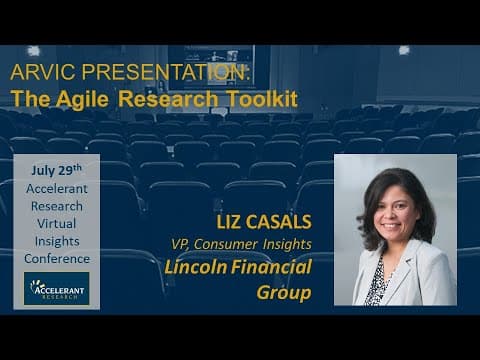
01Adapting Traditional Market Research to an Agile Toolkit: A Journey at Lincoln Financial Group
Liz Castles, head of enterprise consumer insights at Lincoln Financial Group, walks through Lincoln's two-year journey adopting agile research platforms to close the gap between consumer insight and real-time business decision making. She covers the platforms adopted, how her team adapted traditional research processes to fit an experimentation mindset, and the hard-won lessons learned along the way. The talk is grounded in the practical tension between research rigor and speed, and how her team learned to navigate that trade-off inside a highly traditional insurance company.
Watch the talk 02
02Best Practices for Using Crowdsourcing Platforms in Survey Research: The Case of Amazon Mechanical Turk
Dr. Cihan Cobanoglu, McKibben Endowed Chair Professor at the University of South Florida and Director of the M3 Center, walks through the theory and practical mechanics of using Amazon Mechanical Turk for academic and market research. He covers the advantages and risks of crowdsourcing for data collection, the precautions researchers must take to ensure data quality, and delivers a live demonstration connecting a Qualtrics survey to Mechanical Turk. The session is aimed at researchers and practitioners who want a cost-effective, scalable alternative to traditional survey methods.
Watch 03
03Beyond 2020: How Young People Around the World Are Thinking About the Future
Christian Kurtz, Head of Global Streaming and Corporate Insights at ViacomCBS, presents findings from the "Beyond 2020" study, a global survey of over 8,000 people aged 16 to 24 across 15 countries. The research examines how the events of 2020 disrupted young people's lives and reshaped their expectations for the next decade. Key themes include declining happiness, a craving for stability, optimism about personal agency, and rising expectations for brands to take genuine stands on social and environmental issues.
Watch 04
04Democratizing Research Without Jeopardizing Your Job
Sean Good, sole UX researcher at Jane.com, walks through how a one-person research function can extend its reach across an organization without losing quality control or relevance. Drawing on four years of hands-on experience, he covers three practical steps: building bridges with non-research colleagues, delegating research tasks carefully, and protecting yourself and your findings through documentation and transparency. The talk is grounded in real situations from a 200-person e-commerce company and is aimed at researchers working with limited headcount and budget.
WatchWant to be in the room next time?
Register for next conferenceRelated conferences
May 2021 ARVIC
The May 2021 ARVIC conference challenged researchers to sharpen their interview craft and question the validity of common preference measures, with practical methods grounded in real remote-work constraints.
ViewSeptember 30, 2021September 2021 ARVIC
This conference brings together researchers from sports media, consumer products, and entertainment to explore how UX and insights practitioners earn organizational trust, communicate findings clearly, and build durable research cultures.
ViewApril 29, 2021April 2021 ARVIC
The April 2021 ARVIC conference examined researcher responsibility across three fronts: the societal effects of product design, the emotional demands of fast-moving fieldwork, and the data quality foundations that make survey findings trustworthy.
ViewPresent at the next ARVIC
Share a method, a study, or a hard-won lesson with a room of senior research practitioners.