

September 2021 ARVIC
This conference brings together researchers from sports media, consumer products, and entertainment to explore how UX and insights practitioners earn organizational trust, communicate findings clearly, and build durable research cultures.
The September 2021 ARVIC brought together insights and UX research practitioners from Turner Sports, Fender Musical Instruments, and Netflix to address a shared challenge: doing rigorous research is only part of the job. Getting that research used, understood, and trusted by the people who make decisions is where most of the real work happens. Across three talks, speakers drew on hands-on experience in demanding organizational environments to share what it actually takes to build influence, communicate findings, and position research as a strategic asset rather than a supporting function.
Building Research Practices in Non-Traditional Environments
Two talks dealt directly with the challenge of doing UX and insights work inside organizations that were not originally built around research. In sports media, a century of broadcast history means entrenched metrics and workflows that take sustained education and relationship-building to shift. Low UX maturity, not lack of value, is what keeps research roles rare in traditional media. The same dynamic shows up in consumer products, where a data-driven culture can easily become one where data is used to validate decisions already made rather than to lead strategy.
- Invest in cross-functional relationships before findings land, not after. Stakeholders who have skin in the game are far less likely to dismiss results.
- Sustained education and visibility, not a single strong deliverable, is what shifts organizational culture over time.
- For researchers watching growth areas like sports, entertainment, and gaming, the window to position yourself ahead of rising demand is now.
Communicating Findings So They Drive Action
A consistent thread across the conference was the gap between a finding that is technically present in a report and one that actually prompts a decision. Speakers offered concrete techniques for closing that gap.
- Convert percentages to whole numbers when the raw count makes the scale of a problem more visceral. Abstract rates rarely trigger action; a concrete count of real customers often does.
- Surface buried insights explicitly. A finding that appears third on a list and sits behind another percentage will be ignored, even if it is the most actionable thing in the deck.
- Frame every data point as customer feedback. Helping colleagues understand that each number represents a real person telling the company something is the most reliable foundation for a data-led culture.
- Resist over-ordering your outputs. Clean categories can erase the messiest, most important signals. Name what does not fit rather than cutting it to make the story tidy.
Operating Effectively Inside the Organization
Several talks argued that roughly 80% of a researcher's real work is internal: understanding stakeholders, learning their language, and presenting findings in forms those stakeholders can actually use. This reframe has practical implications for how researchers spend their time and how they think about their own role.
- Treat your internal environment as a research project. Identify who your stakeholders are, what problems they are solving, and what data formats they trust.
- Read org charts as relational maps, not just reporting structures. They show who is close to whom and how the organization itself organizes its thinking.
- A rough first draft shared early invites collaborators to take ownership. Starting with something concrete, even something imperfect, moves a group forward faster than waiting for the right answer.
- Suppress assumptions before reaching conclusions. Surveying inactive users in one case revealed a diverse mix of player types and barriers, not the duplicate accounts or product rejection the team initially suspected, and opened several distinct intervention strategies.
Domain-Specific Research Craft
One talk offered a close look at the operational and methodological demands specific to sports media research, with lessons that apply more broadly to any time-constrained or high-context research environment.
- Compressed fielding windows demand advance planning and concurrent workstreams. In sports, the usable research window around a major property can be as short as 20 days.
- Scenario specificity keeps participants engaged and responses reliable. Including plausible contextual details in prompts and prototypes prevents inconsistencies that derail sessions.
- High-passion domains often yield motivated, low-attrition study participants, an operational advantage worth factoring into research design.
Breaking Into Competitive and Niche Roles
Multiple speakers touched on career positioning, with advice grounded in how hiring actually works rather than how candidates typically approach it.
- Cover letters matter more than resumes for niche roles. Articulating how past experience maps to a specific business problem, and demonstrating stakeholder awareness, sets candidates apart more than credentials alone.
- Learn the language of your target employer before writing a word of your application. Informational interviews are the fastest way to surface the specific words and framings that signal fit.
- Shift the interview frame from proving competence to demonstrating that you can help this team solve its specific problem.
Presentations
 01
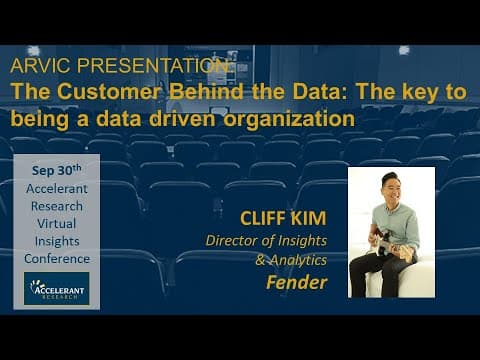
01Humanizing the Numbers: How Fender Uses Customer Storytelling to Drive a Data-Driven Culture
Cliff Kim, Director of Insights and Analytics at Fender Musical Instruments, shares how his team transforms raw analytics into customer stories that drive action across the organization. Using examples from Fender Play, the company's online guitar learning platform, he presents four practical techniques for helping stakeholders see the real people behind the data. The talk is grounded in the challenge of instilling a genuinely data-driven culture, rather than one where data is used to validate decisions already made.
Watch the talk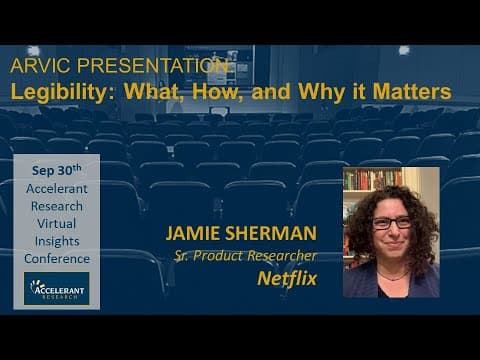 02
02Legibility: What, How, and Why It Matters
Jamie Sherman, Senior Product Researcher at Netflix Studio Insights, uses the concept of "legibility" to pull together practical lessons on job searching, communicating research inside organizations, and translating qualitative insights for business audiences. Drawing on her background in cultural anthropology, theater directing, and nearly a decade at Intel, she argues that roughly 80% of a researcher's real work is internal: understanding stakeholders, learning their language, and presenting findings in forms they can actually use. She closes by complicating her own framework, borrowing from James Scott's critique of legibility to caution against over-ordering insights at the cost of losing what matters most.
Watch 03
03The Guts and Glory of UX Research in Sports Media
Ligia Gill, Senior Manager of UX Research at Turner Sports and Warner Media, shares what it takes to build and run a UX research practice inside a traditional sports media company. She covers the unique complexity of researching sports fans, the operational challenges of compressed fielding windows, and why UXR roles in sports and entertainment have historically been rare. She also offers practical advice for researchers who want to break into the space.
WatchWant to be in the room next time?
Register for next conferenceRelated conferences
October 2021 ARVIC
The October 2021 ARVIC conference focused on making research more durable and trustworthy by building shared ownership, protecting vulnerable participants, and turning qualitative data into concrete, reusable models.
ViewJuly 29, 2021July 2021 ARVIC
The July 2021 ARVIC conference brought together practitioners and academics to tackle how research teams can move faster, scale wider, and stay credible in a rapidly changing environment.
ViewMay 27, 2021May 2021 ARVIC
The May 2021 ARVIC conference challenged researchers to sharpen their interview craft and question the validity of common preference measures, with practical methods grounded in real remote-work constraints.
ViewPresent at the next ARVIC
Share a method, a study, or a hard-won lesson with a room of senior research practitioners.