

March 2025 ARVIC
The March 2025 ARVIC conference centered on restoring human connection as the foundation of research and design practice in an era of growing AI and business pressure.
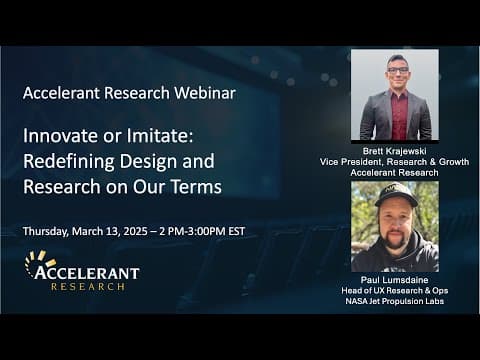
The March 2025 ARVIC conference brought together practitioners to examine what research and design are fundamentally for. Drawing on experience spanning NASA's Jet Propulsion Laboratory, Cisco, and accessibility advocacy, the conversation returned repeatedly to a single tension: as the field grows more fluent in business metrics and emerging tools, it risks drifting from the human connection that gave it a seat at the table in the first place.
Human Connection as the Core Discipline
The conference made a direct case that research and design derive their value not from methodology or tool proficiency, but from the ability to make genuine connections with people. The field's increasing orientation toward product and business framing was identified as a real risk to that foundation.
- Slowing down and asking simple questions surfaces insight that faster, more structured approaches miss.
- Storytelling and relationship-building matter more than technical credentials when influencing stakeholders or making a hire.
- Career growth follows person-to-person connections and community involvement, not automated pipelines.
AI and Tools: Assistants, Not Replacements
New tools, including AI, were welcomed as useful when they address a genuine human need. The boundary drawn was clear: tools assist, but human judgment, ethics, and empathy are not delegable.
AI and new tools are useful when they solve a genuine human need, but they should be treated as assistants. Human judgment, ethics, and connection remain irreplaceable.
Accessibility: Beyond the Baseline
Accessibility guidelines were reframed as a starting point rather than a destination. The only way to know whether an interface actually works is to test it with people who use assistive technologies in their daily lives. Compliance and usability are not the same thing.
Research and Design Collaboration
Practical guidance on cross-functional partnership emphasized relationship before process. Researchers who approach designers with curiosity about design decisions, and who present findings as input rather than verdicts, build the kind of trust that makes collaboration sustainable.
- Build the relationship before bringing a research agenda into the room.
- Ask curious questions about design decisions rather than leading with critique.
- Frame findings as suggestions, not directives.
Related conferences
February 2025 ARVIC
Accelerant Research was proud to present a webinar on Thursday, February 27th titled "Transforming Insights into Results: Advancing Influence in Corporate Landscapes From the Bottom Up" featuring Pavel Samsonov, Senior UX Architect at Amazon.
ViewMarch 27, 2025March 2025 ARVIC
The March 2025 ARVIC conference explored how researchers can produce more credible, actionable insights by strengthening methods, improving data quality, and understanding how AI is reshaping consumer behavior.
ViewFebruary 11, 2025February 2025 ARVIC
The February 2025 ARVIC conference focused on building rigorous, context-aware ad testing programs that translate creative measurement into clear, actionable decisions for insights and product teams.
ViewPresent at the next ARVIC
Share a method, a study, or a hard-won lesson with a room of senior research practitioners.