

March 2023 ARVIC
The March 2023 ARVIC conference brought together practitioners to advance research methods, organizational capability, and the translation of insights into decisions that actually get used.
- 01Does the Respondent Task or Number of Attributes Affect MaxDiff Results?
- 02How to Create a Service Blueprint
- 03Journey Management as a Capability: From Journey Mapping to Activation
- 04Leveraging Empathy to Drive Qualitative Insights Forward
- 05Starting a UX Research Function from the Ground Up
- 06The Failure of UX Personas and How to Make Them Better
The March 2023 ARVIC virtual conference covered ground that matters to anyone responsible for turning research into organizational action. Talks ranged from foundational methods like service blueprinting, journey mapping, and MaxDiff design to higher-order questions about how research functions earn credibility, how personas get built and used, and how empathy shapes the quality of qualitative work. The thread connecting all six sessions: rigor and usability are not in tension. Research that is methodologically sound and designed for the people who need to act on it is the standard every practitioner should be building toward.
Building and Running a Research Function
Two talks addressed the organizational side of research practice directly. One offered a practical playbook for standing up a UX research function inside a low-maturity organization, the other made the case for treating service blueprinting as a cross-functional discipline with real downstream business value. Both converged on the same point: relationships and credibility come before roadmaps and deliverables.
- Spend the first 30 to 60 days doing structured internal discovery before conducting any external studies. Mapping stakeholder constraints, research literacy, and informal research already in flight is the foundation for a phased plan that will actually hold.
- Usability testing is the most reliable path to stakeholder buy-in. Watching real users struggle converts resistant stakeholders faster than any presentation about the value of research.
- Hold off on the internal road show until you have real case studies. Metrics and product manager testimonials carry more weight with executives than methodology explanations.
- Service blueprints have practical downstream uses beyond research, including securing funding for technology investments, informing wireframes, and aligning cross-functional teams during planning sessions.
- Workshop preparation for blueprinting is critical: share materials in advance, run a warm-up exercise, and group participants by the teams they work with daily.
Journey Mapping and Service Blueprinting as Diagnostic Tools
Two sessions treated visual mapping methods as disciplines in their own right, not just workshop outputs. The consistent message was that maps built on internal assumptions rather than real customer research reflect idealized paths, not actual ones, and that static deliverables without a governance model quickly become shelf documents.
- Scope your map before you build it. Macro-level and micro-level mapping serve different purposes; trying to do both at once produces an unfocused output.
- Include the back of the house. Adding organizational activities, team ownership, and systems in play reveals how internal operations create or undermine the customer experience.
- Use arrows in service blueprints to map information flow, not just activities. Handoffs, redundancies, and pain point origins are what turn a diagram into a diagnostic tool.
- Journey maps and journey analytics are different tools. Maps visualize the experience at a point in time; analytics use continuous behavioral data to monitor and optimize in or near real time.
- Plan for continuous updates from the start. Maps that are not revisited every six months to a year quickly become outdated. Build a cadence and governance model before publishing the first version.
Personas That Actually Get Used
One talk made a direct case against the traditional persona format and offered a data science-influenced alternative. The argument is not that personas are the wrong tool; it is that fictional names, stock photos, and point-in-time deliverables reliably produce documents that sit unused. The alternative approach anchors personas to specific product lines, assigns explicit confidence levels based on the volume and variety of data behind them, and treats them as living models that improve with each new round of research.
- Remove names, photos, and fictional details. Assign a behavioral theme instead. Fictional details do not add empathy; they introduce personal interpretation and bias.
- Apply a confidence level to every persona. Low confidence is not a failure; it is a prompt to collect more research before committing to a direction.
- To drive adoption, interview the designers, developers, and product managers who should be using personas and find out why they are not. Build the new format around their stated needs.
Qualitative Practice and the Role of Empathy
One session pushed back on the idea that objectivity is the defining virtue of a qualitative researcher. On sensitive topics especially, empathy, preparation, and a willingness to follow participants off script are what create the conditions for insights researchers would never have thought to ask for.
- Preparation at every touchpoint, from screener to confirmation email to icebreaker, sets the conditions for participant comfort before the session begins.
- Going off script is often where the most valuable insights live. Treat unexpected directions as signal, not noise.
- Qualitative data should be paired with other data types such as surveys or operational data. It should flesh out and make other data compelling, not single-handedly drive major decisions.
- Lean into silence and stay calm when participants share unexpected or difficult things. Overreacting causes participants to shut down.
Quantitative Method Integrity: MaxDiff Design Choices
One controlled experiment tested whether task type and attribute count affect MaxDiff results. The findings are practical and cautionary, particularly for teams running tracking studies.
- End-cap attributes, those ranked most and least important, are robust across design conditions. Mid-ranked attributes are where method choices create measurable variation.
- Task type matters: best/worst selection and reorder interfaces produce different rank orders for middle attributes, even when the same items are shown.
- Attribute count matters: showing three versus five attributes shifts mid-tier rankings, partly because the probability of selection changes with the number of options.
- There is no universally better design. The key is to choose one approach and apply it consistently, especially for tracking studies where changes over time should reflect actual preference shifts, not method changes.
- MaxDiff is scale-invariant, making it useful for cross-cultural and segmentation work, particularly when hierarchical Bayesian estimation is used to extract individual-level utilities.
Presentations
 01
01Does the Respondent Task or Number of Attributes Affect MaxDiff Results?
Researchers from an MMR graduate program ran a controlled experiment to test whether two methodological choices in MaxDiff design, the respondent task type (reorder vs. best/worst selection) and the number of attributes shown (three vs. five), produce meaningfully different results. Across two product categories, flights and dining, the top and bottom ranked attributes remained stable regardless of design condition, but mid-ranked attributes shifted depending on how the question was asked and how many options were shown. The core practical message is consistency: pick a design and stick with it, especially when tracking over time.
Watch the talk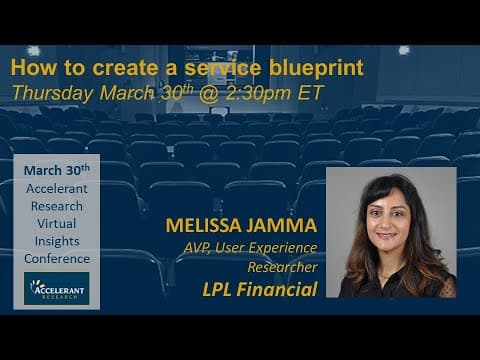 02
02How to Create a Service Blueprint
Melissa Jamma, Product Experience Researcher at LPL Financial, walks through her end-to-end process for building service blueprints, using two real examples from her career: a university instructor contract signing service and a financial advisor business model transition. The talk covers what service blueprinting is, why it matters, and the concrete steps required to run workshops and turn outputs into actionable diagrams.
Watch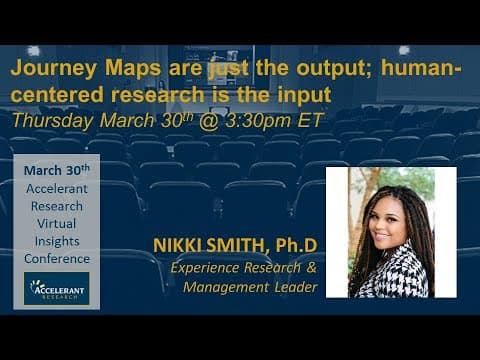 03
03Journey Management as a Capability: From Journey Mapping to Activation
Dr. Nikki Smith, a practitioner in experience management, walks through customer journey management as an organizational capability, with a focused look at journey mapping as a discipline within it. She covers what makes journey maps useful and where they fall short, how to ground them in real research, and how organizations can scale toward continuous journey optimization. The talk is aimed at researchers, CX practitioners, and insights leaders looking to move beyond static deliverables toward ongoing, data-informed experience improvement.
Watch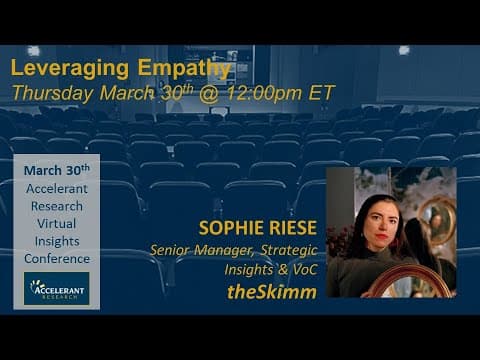 04
04Leveraging Empathy to Drive Qualitative Insights Forward
Sophie Reese, Senior Manager of Strategic Insights and Voice of the Customer, argues that empathy, not objectivity, is the most critical skill in qualitative research, especially on sensitive topics. She walks through how careful preparation, active listening, and a willingness to go off script create the conditions for participants to share insights researchers would never have thought to ask for. The talk draws on over a decade of experience across finance, health, family law, media, and education.
Watch 05
05Starting a UX Research Function from the Ground Up
Mary Curran, Senior Manager of UX Research at Warner Music Group, draws on eight years of experience building research functions from scratch to walk through a practical playbook for scaling research inside organizations with low UX maturity. She covers internal discovery, research ops planning, democratization with guardrails, research strategy workshops, and how to build the internal relationships and visibility that make research stick. The talk is grounded in real examples from Warner Music and earlier roles in SaaS and e-commerce.
Watch 06
06The Failure of UX Personas and How to Make Them Better
Alex, UX Research Manager at US Bank, argues that traditional user personas fail because fictional details, stock photos, and made-up names introduce bias and produce documents nobody actually uses. Drawing on data science methodology, she presents a product-anchored, iteratively trained approach to personas that produces actionable behavioral predictions with explicit confidence levels, giving design, product, and development teams a shared, defensible starting point.
WatchWant to be in the room next time?
Register for next conferenceRelated conferences
August 2023 ARVIC
The August 2023 ARVIC conference united researchers and practitioners around a single conviction: rigorous methods only deliver value when paired with sharp communication, organizational buy-in, and strategic ambition.
ViewOctober 27, 2022October 2022 ARVIC
The October 2022 ARVIC conference brought together insights practitioners from major consumer brands to share hands-on methods for connecting behavioral data, scaling research operations, and communicating findings with greater credibility and impact.
ViewOctober 26, 2023October 2023 ARVIC
The October 2023 ARVIC conference focused on how researchers can build more durable, actionable programs by rethinking how they communicate findings, engage stakeholders, and integrate AI into their work.
ViewPresent at the next ARVIC
Share a method, a study, or a hard-won lesson with a room of senior research practitioners.