


October 2026 ARVIC
The October 2026 ARVIC conference examined how research teams can embed rigor, structure, and human judgment into democratized programs, internal data operations, and insight delivery to drive real decisions.
Across three talks, the October 2026 ARVIC brought a consistent challenge into focus: research activity is expanding, but research quality is not keeping pace. Whether the topic was democratization governance, internal data hygiene, or insight storytelling, every session returned to the same core tension. Organizations are generating more outputs, faster, and with more tools than ever before. What they are not doing, consistently, is ensuring those outputs are rigorous enough to act on. The sessions offered practical frameworks for closing that gap.
Governing Democratization Before It Governs You
One session made a pointed argument: research democratization is not a future decision for most organizations. It is already happening informally. The real choice is whether to govern it. Without deliberate training, templates, and guard rails, teams produce what the presenters called research theater: outputs that look credible but lack the rigor to survive scrutiny at senior levels.
- AI raises the speed of research activity but, according to practitioner survey data, does not raise the quality of findings. Governance frameworks must account for this explicitly.
- Research thinking, defined as empathy, curiosity, humility, objectivity, and rigor, is the missing ingredient in most democratization programs. It must be embedded in both human training and AI workflows the same way.
- Programs with bottom-up advocates and top-level visibility tend to succeed. Programs driven purely by executive cost-cutting are a warning sign worth taking seriously.
Building the Data Foundation Before Calling In Research
A second session shifted attention upstream, to the internal data work that should precede any external research engagement. Using a SaaS membership renewal problem as a concrete example, the presenter walked through a six-step method: name the problem, assign owners, scope the data needed, aggregate it, fix gaps, then act. The result is both a cleaner brief and faster leadership buy-in.
- Clean data is a byproduct of a clean process. Naming inconsistencies, ownership gaps, and siloed tools must be resolved before any analysis, internal or external, can be trusted.
- Unique identifier inconsistencies across platforms are among the most common and costly sources of bad output. Standardizing them early is a high-value, low-cost fix.
- The decision to commission external research should depend on company size and resources. Smaller organizations often have direct client access that larger ones do not.
- If research results already exist, the same six-step process runs in reverse: connect internal systems to measure whether recommended changes are actually being implemented.
Delivering Insights That Actually Move Stakeholders
A third session addressed the final mile: turning findings into decisions. Drawing on a blinded hardware concept-test case study, the presenter argued that two underused tools, the Five Whys root cause technique and a well-constructed research brief, separate adequate deliverables from ones that produce action.
- Elevated insights do more than confirm a hypothesis. They surface human truths, reframe the real problem, and point toward a future direction.
- A sharp brief should force stakeholders to answer one question: what would the researcher have to deliver for the engagement to be called a win? That answer anchors the entire project.
- When stakeholders are hard to reach, sharing a concrete draft assumption and asking for a yes or no gets faster responses than open-ended questions.
- Visualizing data on two axes mapped to the competing priorities in the room communicates findings faster than a full attribute grid.
- A one-page summary naming the top recommendation and the key competitive caveat is more durable than a complete deck. AI can help generate initial frameworks and draft visuals, but identifying nuance and emotional stakes still requires human judgment.
The Common Thread
All three sessions pointed at the same underlying problem from different angles. More tools, more data, and more AI capability do not automatically produce better research. Rigor requires deliberate choices: governance structures, clean data infrastructure, and deliverables designed around the decisions stakeholders actually need to make. The October 2026 ARVIC was, in effect, a practical guide to making those choices intentionally rather than by default.
Presentations
 01
BEYOND THE PLOT: Directing Elevated Insights
Loretta Hudalot draws a parallel between "good" movies and "elevated" movies to explain what separates adequate research deliverables from ones that move stakeholders to action. She argues that two deceptively simple tools, the Five Whys exercise and a well-constructed research brief, are the practical levers for getting there. A blinded hardware concept-test case study shows what the shift from a data grid to a human-centered story looks like in practice.
Watch the talk 02
Internal Operations: How startups learn from their own data & when to call in research
Julia Schwan, founder of Opero, draws on a decade of finance and operations experience across startups and large corporations to present a six-step method for aggregating internal data before deciding whether to commission external research. Using a SaaS membership renewal problem as a running case study, she shows how disconnected tools and inconsistent data identifiers obscure business problems, and how centralizing that data produces both cleaner decisions and stronger briefs for research partners. The talk is equally relevant to lean startups with limited budgets and to larger organizations that receive research results but lack the data infrastructure to act on them.
Watch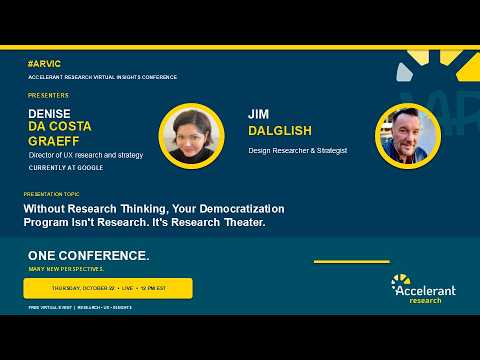 03
Without Research Thinking, Your Democratization Program Isn't Research. It's Research Theater.
Denise and Jim, UX researchers and strategists, argue that research democratization is already happening everywhere, whether organizations plan for it or not, and that the real risk is not democratization itself but democratization without research thinking. Drawing on desk research, interviews with 12 practitioners, and vendor studies, they diagnose what makes programs fail and propose a four-cornerstone framework for embedding research thinking into any program, including AI-assisted work.
WatchWant to be in the room next time?
Register for next conferenceRelated conferences
 November 19, 2026
November 2026 ARVIC
ViewAugust 20, 2026August 2026 ARVIC
The August 2026 ARVIC conference focused on the fundamentals of rigorous research practice, covering how to eliminate bias from study design and how structured process discipline turns raw data into actionable business decisions.
ViewJune 17, 2026June 2026 ARVIC
The June 2026 ARVIC conference challenged insights professionals to move beyond reactive habits, treating fraud, personalization, ethics, and AI as interconnected forces that demand proactive, human-centered strategy.
ViewPresent at the next ARVIC
Share a method, a study, or a hard-won lesson with a room of senior research practitioners.