

December 2024 ARVIC
The December 2024 ARVIC conference focused on defending research quality against survey fraud, presenting practical, layered techniques for detecting and removing bad actors from panel-sourced data.
The December 2024 ARVIC virtual conference brought together market research practitioners to address one of the field's most pressing data-quality challenges: the surge in survey fraud. Drawing on firsthand experience across major research organizations, the session delivered actionable frameworks and concrete techniques for protecting the integrity of panel-sourced research.
The Scale of the Problem
Fraud in panel-sourced surveys is not a fringe concern. Reported fraud rates range from 30 to 50 percent, with some practitioners citing figures as high as 70 percent. At that scale, contaminated data can materially distort business decisions, making fraud defense a strategic priority rather than a methodological footnote.
A Three-Stage Defense Framework
The conference centered on a structured approach to fraud prevention built around three stages: deny, trap, and toss. The core message is that no single technique is sufficient. Effective defense requires layering controls across all three stages simultaneously.
- Deny: Automated pre-survey controls that block known bad actors before they enter the instrument.
- Trap: In-survey detection techniques, including explicit attention checks that instruct respondents which answer to select, which alone can catch 5 to 10 percent of fraudulent responses.
- Toss: Post-survey data scrubbing to remove responses that passed earlier checks but show fraud signals in the cleaned dataset.
Key Detection Signals
Open-ended questions emerged as one of the most reliable indicators of fraud. AI-generated responses, copy-pasted text, question-echoing phrasing, and identical verbatim answers appearing across multiple respondents are strong signals of bots or click-farm activity and should be prioritized in any post-survey review.
Smarter Termination and Incentive Design
Two practical refinements can meaningfully improve defense over time. First, researchers should avoid terminating respondents immediately after a failed trap question. Delayed or mystery terminations prevent bots from identifying which checks caught them, reducing their ability to adapt. Second, restructuring incentives toward charity donations, promo codes, or swag reduces the financial appeal of surveys to automated bad actors without penalizing genuine respondents.
Presentations
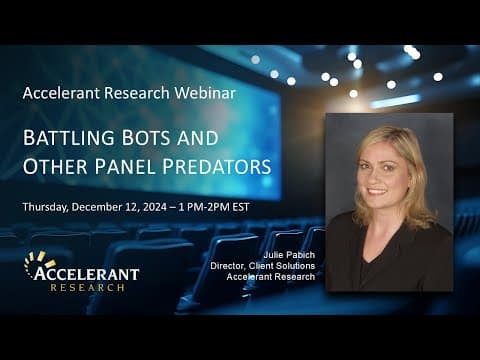 01
01Battling Bots and Other Online Predators in Market Research
Julie Pavit, a market research veteran with experience at Nielsen, Johnson Controls, and Accelerant Research, walks through the growing threat of survey fraud, including bots, click farms, and ghost completes. She presents a three-stage framework, deny, trap, and toss, covering automated defenses, in-survey detection techniques, and post-survey data cleaning. She closes with ideas for restructuring incentives to make surveys less attractive to bad actors.
Watch the talkWant to be in the room next time?
Register for next conferenceRelated conferences
November 2024 ARVIC
The November 2024 ARVIC conference pressed insights and UX professionals to modernize their practices, broaden their roles, and use AI and agile methods to stay strategically relevant.
ViewJanuary 16, 2025January 2025 ARVIC
The January 2025 ARVIC conference focused on making UX research financially legible to business stakeholders through a practical, conservative, and credible framework for calculating and communicating ROI.
ViewFebruary 11, 2025February 2025 ARVIC
The February 2025 ARVIC conference focused on building rigorous, context-aware ad testing programs that translate creative measurement into clear, actionable decisions for insights and product teams.
ViewPresent at the next ARVIC
Share a method, a study, or a hard-won lesson with a room of senior research practitioners.