

November 2024 ARVIC
The November 2024 ARVIC conference pressed insights and UX professionals to modernize their practices, broaden their roles, and use AI and agile methods to stay strategically relevant.
- 01Expired Insights: Why Research Must Evolve as Fast as the World Does
- 02The Evolution of UX Research in a Turbulent Tech Market
- 03The First 30 Days: How to Activate Mobile App Users and Build Lasting Engagement
- 04The UX Generalist Advantage Powered by AI
- 05What My Market Research Parents Missed: Habits We Need to Break
Across five talks, the November 2024 ARVIC conference returned repeatedly to a single tension: the gap between how insights and UX research teams currently operate and what the business actually needs from them. Speakers from Airship, Vail Resorts, JP Morgan Chase, and Lucid Motors, joined by an independent B2B practitioner, each attacked a different corner of that gap. Together they made a cumulative case for researchers who are faster, more strategic, more cross-functional, and more honest about when their inputs have gone stale.
The Cost of Staying Tactical
The sharpest thread running through the conference was a warning against tactical, siloed research practice. Two talks addressed this most directly. The UXR lead from JP Morgan Chase argued that researchers confined to usability work are the most exposed to layoffs, and laid out a concrete path toward strategic influence: frame the right problem first, then tie outputs to business OKRs and product vision. The Vail Resorts speaker made the same argument from a career angle, urging researchers to stop waiting to be asked and to sit in strategy meetings, join creative briefings, and lead with outcomes rather than methodology.
- Strategic researchers who connect findings to revenue and business outcomes are more resilient than those doing evaluative work alone.
- Starting a conversation with methodology loses the room. Lead with the outcome the partner needs, then back into the method.
- In conservative industries like finance and healthcare, trust-building through fast evaluative work comes before strategic influence.
- Reframing a problem often surfaces faster and cheaper solutions than the stated ask would have produced.
Keeping Insights Fresh and Honest
Two talks pushed directly on the shelf life of research. The B2B practitioner made the case for quarterly audits at minimum, and immediate reviews after any major global disruption. The Vail Resorts speaker added a behavioral dimension, arguing that gatekeeping data and perfectionism are habits inherited from an earlier era that now actively slow teams down.
- Audit screeners, survey questions, and standing trackers regularly. Stale questions cost money and crowd out better ones.
- Widen recruiting criteria beyond conventional definitions of the target audience, including marketers, retirees, and non-traditional respondents.
- Sharing work-in-progress builds trust. Partners who ask for raw data are usually exploring, not auditing your methodology.
- Match the delivery format to how your audience actually consumes information. A 100-page deck is not a neutral choice.
- Adopt the agile approach: deliver a solid, timely answer now and reserve the right to update as new information arrives.
Activation and Engagement as a Research Discipline
The Airship talk brought a data-rich perspective on mobile app activation that has direct implications for anyone designing research around user behavior. With the cost per app download rising since iOS 14 privacy changes, the efficiency of the first 30 days matters more than it used to. The research presented quantified what best-in-class activation actually looks like.
- Identified users return to an app at day 30 at a 17% rate versus 4% for anonymous users, and they purchase more frequently and at higher average order values.
- Onboarding opt-in campaigns can lift push permission rates up to 40% above the category average. A soft prompt before the OS system prompt is the recommended approach.
- Audience targeting based on stated preferences produces roughly a 59% lift in purchase conversion on average, with top performers reaching up to 90%.
- Preference gathering is continuous, not a one-time onboarding step. Preference centers, interest surveys, and contextual data collection all contribute over time.
The Generalist Advantage and AI as a Force Multiplier
Two talks addressed the expanding skill expectations on UX and insights professionals and the role AI tools now play. The Lucid Motors speaker made the case for a generalist profile: deep research expertise paired with strategy, basic design fluency, and cross-functional communication. AI was framed as a way to handle volume-heavy tasks so practitioners can focus on interpretation and decision-making, not as a replacement for judgment.
- UX job postings dropped sharply from 2022 to 2023 but remain 53% above 2018 levels, and roles were recovering as of mid-2024.
- AI tools accelerate secondary research, thematic analysis, persona drafting, and survey design. Treat outputs as starting points and review for hallucinations.
- Follow your organization's IT and infosec policies before inputting proprietary or user data into external AI platforms.
- Diversifying skills does not mean learning every methodology. It means applying the same critical thinking across UX research, CX research, service design, and design strategy at different scopes.
- Market research is the foundation of CX, UX, and EX. Broaden the role rather than treating adjacent disciplines as competition.
The Qualitative Differentiator
Several speakers converged on a point worth naming separately. Most organizations are already data-rich on the behavioral side. The why behind the what is where insights teams have room to win. Qualitative research, storytelling, and humanizing findings were cited not as soft skills but as competitive differentiators in a landscape saturated with dashboards and trackers.
If you take away one thing: humanize your research, and throw out the expired.
Presentations
 01
01Expired Insights: Why Research Must Evolve as Fast as the World Does
A market research practitioner argues that insights have a shelf life, and that relying on outdated findings leads to missed opportunities and flawed strategy. Drawing on examples from consumer behavior, industry disruption, and her own B2B research practice, the speaker makes the case for continuously auditing research inputs, methods, and audiences. She closes with three practical levers for keeping insights fresh: continuous culture, abstract problem solving, and storytelling.
Watch the talk 02
02The Evolution of UX Research in a Turbulent Tech Market
Rema, a UXR lead at JP Morgan Chase, surveys the recent contraction in UX research hiring and argues that researchers who remain tactical and siloed are most at risk. She presents three concrete moves toward becoming a strategic researcher: framing the right problem, tying outputs directly to business results, and broadening skills across adjacent research disciplines.
Watch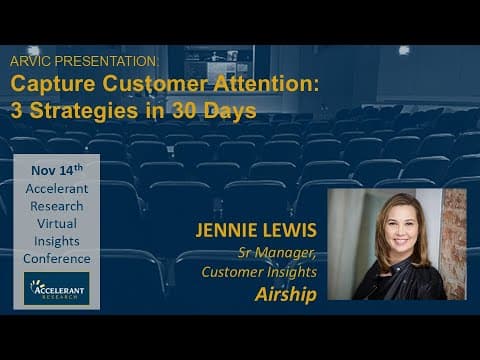 03
03The First 30 Days: How to Activate Mobile App Users and Build Lasting Engagement
Jenny Lewis, Head of Customer Insights at Airship, presents research on the "activation phase," the first 30 days after a mobile app download. She outlines three strategies that separate high-performing apps from average ones: identifying the customer, securing push opt-in, and gathering preferences. Each strategy is linked to measurable outcomes including purchase frequency, session lift, and conversion rates.
Watch 04
04The UX Generalist Advantage Powered by AI
Proshanjit Mitra, Lead UX Research and Strategy at Lucid Motors, makes the case for UX professionals to broaden their skills into strategy, design, and adjacent domains while using AI tools to handle more work without sacrificing quality. The talk covers the current UX job market, the expanding skill expectations in job postings, and practical AI use cases drawn from Mitra's own experience. It closes with best practices for responsible AI adoption and advice on staying competitive as the field evolves.
Watch 05
05What My Market Research Parents Missed: Habits We Need to Break
Solomon Bennett, Senior Director of Guest Insights at Vail Resorts, reflects on four deeply ingrained habits he inherited early in his research career and argues that each one now actively undermines the relevance of insights teams. Drawing on conversations with peers at a recent industry conference, he maps a path from a siloed, perfectionist, gatekeeping support function to an agile, collaborative, and indispensable business partner.
WatchWant to be in the room next time?
Register for next conferenceRelated conferences
December 2024 ARVIC
The December 2024 ARVIC conference focused on defending research quality against survey fraud, presenting practical, layered techniques for detecting and removing bad actors from panel-sourced data.
ViewSeptember 26, 2024September 2024 ARVIC
The September 2024 ARVIC brought together insights leaders to argue that the profession's future belongs to those who interpret, socialize, and connect data rather than simply collect and report it.
ViewJanuary 16, 2025January 2025 ARVIC
The January 2025 ARVIC conference focused on making UX research financially legible to business stakeholders through a practical, conservative, and credible framework for calculating and communicating ROI.
ViewPresent at the next ARVIC
Share a method, a study, or a hard-won lesson with a room of senior research practitioners.