

August 2020 ARVIC
The August 2020 ARVIC conference examined how research and innovation teams can deliver sharper, more actionable insights by prioritizing quality, adaptability, and practical execution over scale and convention.
Held in August 2020, ARVIC brought together practitioners from insights, media, and innovation to address a shared challenge: how do you produce reliable, decision-ready findings when the rules of the game have just changed? Four sessions covered qualitative interview craft, storytelling measurement, virtual research execution, and continuous innovation, each returning to the same underlying argument: doing fewer things with more intention beats doing more things with less.
Qualitative Rigor at Small Scale
Two sessions made a strong case for deliberate, well-controlled qualitative work over volume. The detective-turned-researcher framing of one talk challenged the assumption that larger samples or algorithmic tools produce better insights. The online qualitative session extended that argument into execution, showing how virtual methods can match or improve on in-person fieldwork when logistics are handled carefully.
- Recruit deliberately. Distinguishing customers, potential customers, and non-customers on the front end is what makes small-sample research credible.
- Stop at saturation. In applied settings, themes typically repeat by 5 to 12 interviews. Failure to reach saturation by 12 signals a recruitment or discussion-guide problem.
- Avoid asking 'why.' Probes like 'tell me more' and 'what made you decide to do X' surface emotional drivers that direct questions miss.
- Right-size virtual groups. Dyads and triads tend to produce more intimate, usable discussions than six-to-eight-person webcam sessions.
- Run tech checks during recruitment, not on the day of the interview. Platform selection should follow research objectives, not default to a standing subscription.
From Findings to Counsel
Both qualitative sessions pushed against the habit of handing stakeholders a menu of options. Researchers were urged to deliver a clear point of view and a specific recommendation. Recording and transcribing every interview, then coding for themes, was presented as the minimum standard for sharing credible evidence with decision-makers. Webcam video capture also creates a flexible deliverable: recorded sessions can be cut into sizzle reels for stakeholders who cannot observe live.
Measuring What Makes Stories Work
The ESPN session showed what rigorous mixed-methods research looks like when it is built to drive content decisions. A five-quality framework, grounded in structural equation modeling across nearly 70 real stories and 1,200 sports fans, now guides editorial choices across formats and sports.
- Relatability is the single most important storytelling quality, predicting the majority of entertainment value, brand affinity, league affinity, and recommendation intent across every sport studied.
- The five qualities together (relatability, substance, provocation, humor, and conversational) explain 64 to 77 percent of why fans respond to a story.
- Different qualities move different KPIs: substance drives brand affinity, humor matters more for entertainment in soccer and baseball, and provocative content has seven times more impact on entertainment value for Gen Z.
- Gen Z fans expect brands to take clear stances; older millennials prefer brands to provide context and let them form their own views. That generational tension is a live strategic challenge for media brands.
- The framework was made operational through a content optimizer tool that lets teams input a target KPI, sport, and demographic to identify which storytelling attributes to prioritize.
Continuous Innovation as Operational Practice
The innovation session used the 2020 Online World Joggling Championships as a concrete case study in why organizations should maintain an active idea backlog rather than innovate only when a crisis forces the issue. A video-submission concept deprioritized in a 2019 brainstorming session became the blueprint for a globally attended event when the pandemic eliminated in-person options.
- Business models can change overnight. March 2020 demonstrated that disruption does not announce itself on a three-to-five-year horizon.
- Innovation is a practiced skill. Organizations that innovate continuously are better positioned to respond than those that only act when a problem forces them to.
- Related-worlds thinking is a concrete method: examining how other industries or cultures solve analogous problems has produced innovations from Gutenberg's press to Japan's bullet train.
- Beta testing with real users surfaces design problems early, before full launch and before stakeholders are watching.
The Through-Line
Across all four sessions, the conference returned to a consistent position: preparation, deliberate design, and clear delivery outperform scale and improvisation. Whether the context is a qualitative guide, a content framework, a virtual fieldwork plan, or an innovation backlog, the advantage goes to teams that have done the thinking before the pressure arrives.
Presentations
 01
01How to Interview Like a Detective
Dr. Ari Zilmanow, a former police detective turned insights professional, makes the case for prioritizing qualitative interview quality over data quantity. Using cases from his detective career and the near-failure of Febreze, he argues that a small number of well-designed interviews can surface insights that large datasets and algorithmic tools routinely miss. The talk covers research planning, interview design, fieldwork technique, and how to deliver findings as actionable counsel rather than raw data.
Watch the talk 02
02Innovation in Sports: Running While Multitasking Online
Lynn Furman, consultant and adjunct professor at the University of North Florida, draws on his background in corporate innovation and the niche sport of joggling to illustrate how continuous innovation processes prepare organizations for sudden disruption. Using the 2020 Online World Joggling Championships as a case study, he shows how a brainstormed idea shelved in 2019 became the blueprint for an event that attracted global participation when the pandemic eliminated in-person options. The talk closes with practical takeaways on why organizations must innovate continuously rather than reactively.
Watch 03
03The Power of Storytelling in Sports: The Method Behind the Magic
Renata Polacicio, VP of Research and Insights at ESPN, presents a mixed-methods study ESPN conducted to identify and measure what makes sports stories powerful and memorable. The research produced a five-quality framework, grounded in structural equation modeling across nearly 70 real stories and 1,200 sports fans, that ESPN now uses to guide content decisions. Relatability emerged as the single most important quality, predicting the majority of entertainment value, brand affinity, league affinity, and recommendation intent across every sport studied.
Watch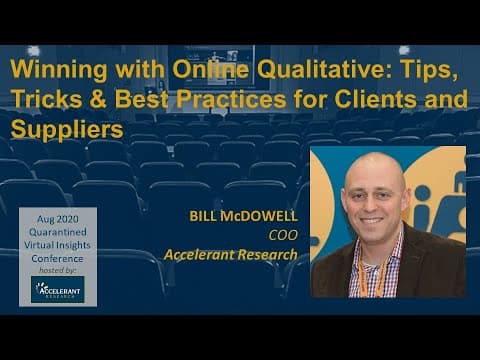 04
04Winning with Online Qualitative Research: Tips, Tricks, and Best Practices for Clients and Suppliers
Bill McDowell, CEO of Accelerant Research, closes out the August 2020 ARVIC conference with a practical, demonstration-heavy session on adapting qualitative research methods for a fully virtual environment. Drawing on Accelerant's own experience with online qual and the industry-wide shift forced by the pandemic, he walks through specific techniques for replacing in-person focus groups, ethnographies, shop-alongs, product tests, and neuro research with webcam-based and asynchronous alternatives. The talk emphasizes logistics and execution over analysis, with live participant demos and candid notes on what can go wrong.
WatchRelated conferences
October 2020 ARVIC
The October 2020 ARVIC conference brought together insights practitioners to share how rigorous research operations, adaptive tracking, and strategic integration with emerging technology keep the discipline indispensable in a rapidly changing environment.
ViewMay 29, 2020May 2020 ARVIC
The May 2020 ARVIC conference brought together insights, marketing, and product leaders to explore how COVID-19 was reshaping consumer behavior, research methods, and business strategy across categories.
ViewApril 17, 2020April 2020 ARVIC
The April 2020 ARVIC conference examined how COVID-19 was reshaping research practice, consumer behavior, and organizational decision-making, while surfacing enduring principles around rigor, ethics, and influence.
ViewPresent at the next ARVIC
Share a method, a study, or a hard-won lesson with a room of senior research practitioners.