

October 2020 ARVIC
The October 2020 ARVIC conference brought together insights practitioners to share how rigorous research operations, adaptive tracking, and strategic integration with emerging technology keep the discipline indispensable in a rapidly changing environment.
- 01Give Me More Dolly Parton: A PBS Country Music Documentary Research Journey
- 02Hiring Research Rock Stars: Dimensions, Interview Techniques, and Sourcing Strategies
- 03Integrated Insights for Today's Tough Questions: Designing Multi-Method Research Programs
- 04Operational Excellence and an Outcome-Driven Approach for UX Research
- 05Reinventing Brand Measurement: A Seven-Year Journey at Ally Financial
- 06Research in the Intelligence Age: Staying Relevant in the AI Revolution
- 07Staying the Course: How NASCAR's Consumer Insights Team Navigated an Unprecedented Year
- 08The Five Fundamentals of In-Depth Interviews: How the Best User Research Is User Therapy
- 09Tracking Consumers Through COVID-19: How Wolverine Worldwide Mobilized a Seven-Month Insights Tracker
Across nine sessions, the October 2020 ARVIC conference addressed a consistent set of pressures facing the insights function: organizations moving faster than traditional research can follow, AI reshaping how data is processed, and a global pandemic forcing teams to rebuild plans from scratch. Speakers responded not with calls to abandon established methods but with practical frameworks for making research more rigorous, more integrated, and more clearly tied to decisions. The talks span brand tracking, UX research, longitudinal consumer panels, hiring, interviewing craft, multi-method program design, and AI strategy, but the through-line is the same: research teams that operate with intention and communicate with discipline earn a seat at the table.
Running the Research Function as a Discipline
Several sessions turned the lens inward, treating the insights team itself as an object of study. One team applied the same outcome-driven framework they use for customers to their own operations, covering six phases of the research process and a set of cross-cutting enablers. The result was a shared language that scaled across org structures and immediately generated three workstreams: research quality measurement, a structured interview question bank, and a team skills self-assessment. The self-assessment, covering competence, motivation, and confidence, surfaced quantitative methods as the clearest gap and forced an explicit choice about whether to build that capability internally or lean on adjacent teams.
The hiring sessions reinforced that operational discipline extends to talent acquisition. Speakers from Zillow and TIAA both emphasized behavioral interviewing, structured question banks, and non-traditional sourcing channels including contract workers, internal partners, and vendor referrals. Hard-to-teach attributes, empathy, curiosity, storytelling ability, and negotiation instinct, were consistently ranked above product knowledge, which can be trained.
- Build frameworks with full team input but assign one owner to the initial draft to maintain momentum.
- Identify concrete use cases before finalizing any operational framework so owners can be assigned immediately.
- Treat negotiation aptitude as a financial skill with measurable organizational value, not a soft competency.
- Behavioral interview questions should also set honest expectations about job pace and stress.
Craft at the Individual Researcher Level
Two sessions made the case that research quality ultimately depends on what happens in the room between a researcher and a participant. Drawing on clinical psychology and therapeutic interviewing, one speaker presented five fundamentals for in-depth interviews and argued that the same three conditions that predict therapy success, rapport, unconditional positive regard, and therapeutic alliance, also predict the quality of research sessions and cross-functional partnerships. Practical guidance included coding participant statements line by line to surface mental models, building discussion guides collaboratively with stakeholders before fieldwork, delegating operational tasks so the lead researcher stays fully present, and debriefing immediately after each session before findings blur.
A separate session on a long-form documentary research program offered a candid counterpoint: running eight rounds of quantitative studies across duplicated samples exceeded what was necessary. When results align across multiple studies, that is a signal to stop testing, not to add more waves. The clearest missed opportunity named by the speaker was the absence of even one qualitative phase, despite an early quantitative signal that warranted follow-up.
Tracking and Longitudinal Research in Volatile Conditions
Three sessions dealt directly with research conducted under pandemic conditions, and each reinforced the value of continuity and curation over volume. A seven-month consumer tracker launched one week into the U.S. shutdown followed the same 100 participants across nine waves, making wave-over-wave sentiment shifts meaningful rather than anecdotal. A general-population sample was augmented with brand-relevant segments, and findings were organized into clusters of three: what consumers felt, what they did, and what they needed. Distribution evolved away from long decks toward a one-page newsletter, an internal research library, and a planned podcast to reach stakeholders who prefer listening over reading.
A seven-year brand measurement evolution at a financial services firm demonstrated that iterative change outperforms methodological overhauls. Early wins came from simple adjustments before any structural changes were made. Consolidating two brand surveys into one freed budget that funded a six-vendor specialist ecosystem. Daily fielding revealed market events that quarterly point-in-time tracking would have missed entirely. The consistent principle across both talks: preserve trend continuity by routing new monitoring needs through always-on or syndicated tools rather than altering core trackers mid-flight.
Adapting When the Plan No Longer Holds
The NASCAR session offered one of the conference's most direct accounts of research under pressure. When the 2020 plan was invalidated, the team simplified immediately: identify the handful of KPIs still measurable and orient all activity around them. Third-party research aggregation, synthesizing external findings into a weekly executive brief, kept the insights function visible and useful when custom research was neither feasible nor tactful. A competitive calendar of other leagues' return timelines, built entirely from public sources, gave leadership a clear broadcast landscape view and helped the organization move first. The team was also explicit about the limits of research in values-driven decisions: research did not drive the Confederate flag ban, but it quantified likely impact and supplied post-announcement reassurance.
- Avoid asking panels about spending or return intentions before conditions make the question appropriate.
- Curating and synthesizing external findings is a legitimate, high-value deliverable when custom research is constrained.
- Being first back to live programming produced measurable audience gains because there was no competition for live content.
Multi-Method Program Design and Activation
A session on complex, long-term strategic questions made the case for replacing single- or two-phase projects with structured multi-method research programs. The core discipline is mapping every key research question to a specific method or information source before fieldwork begins, which reveals gaps, prevents redundancy, and creates stakeholder alignment upfront. Internal subject-matter experts, regional managers, and customer care staff should be treated as information sources on par with formal methods and brought in at the right stage rather than consulted only at the end. The recommendation to hold the full story until data across all or most methods is in hand guards against partial findings misleading stakeholders before the picture is complete.
AI Integration as a Strategic Responsibility
The conference's most forward-looking session argued that AI is a tool for insights teams today, not a future consideration. With over 80 percent of data produced today being unstructured, traditional methods alone cannot keep pace at scale. The speaker presented two practical roles for insights teams: embedding AI tools to accelerate insight generation, and using traditional research methods to audit, pressure-test, and refine AI and machine learning solutions. Insights teams can add concrete value to data science partnerships by building upfront hypotheses, verifying data authenticity, flagging imbalances in training data, and gathering ongoing stakeholder feedback after deployment.
Human intelligence is not replaceable by AI. AI mimics human reasoning but does not replicate consciousness, emotional nuance, or creativity.
The call for diverse perspectives in AI development was not abstract. The session grounded it in the history of computing itself, noting that contributions from outside the mainstream shaped the field in foundational ways. For insights teams building AI partnerships today, that history is a practical argument for inclusive input into how models are trained and where they are applied.
Presentations
 01
01Give Me More Dolly Parton: A PBS Country Music Documentary Research Journey
Eliza Jacobs, Director of Consumer Insights and Analysis at PBS, walks through 15 months of quantitative research conducted in support of Ken Burns' eight-episode documentary "Country Music," which premiered on PBS in September 2019. She covers the strategic challenges the film posed, the research methods used to optimize promotional assets, and what the outcomes revealed about audience expansion and the limits of survey-only research programs.
Watch the talk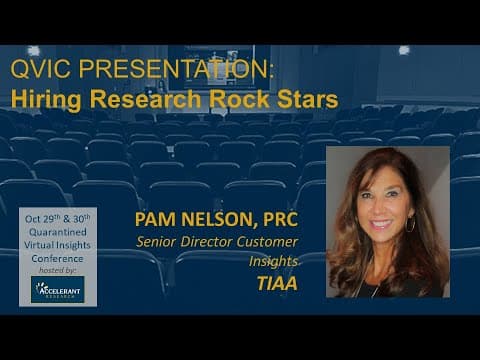 02
02Hiring Research Rock Stars: Dimensions, Interview Techniques, and Sourcing Strategies
Pam Nelson, Senior Director of Customer Insights at TIAA, draws on 27 years of hiring experience to outline what separates research rock stars from average candidates on the client side. She covers the key dimensions to screen for, a behavioral interviewing approach, and a range of sourcing channels that go well beyond standard job postings. The session includes live audience prompts and Q&A on topics such as data visualization skills and non-traditional hiring paths.
Watch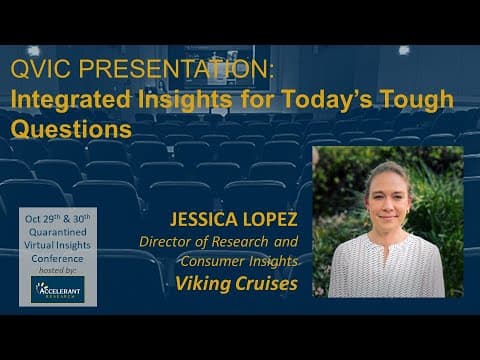 03
03Integrated Insights for Today's Tough Questions: Designing Multi-Method Research Programs
Jessica Lopez, Director of Research and Consumer Insights at Viking Cruises, makes the case for replacing single- or two-phase research projects with structured, multi-method research programs when the strategic question is complex or long-term. Drawing on a child care provider market expansion study, she walks through three core components of this approach: rigorous planning, question-to-method mapping, and deliberate use of people as information sources throughout the research lifecycle. The session includes practical guidance on analysis, reporting, and activation.
Watch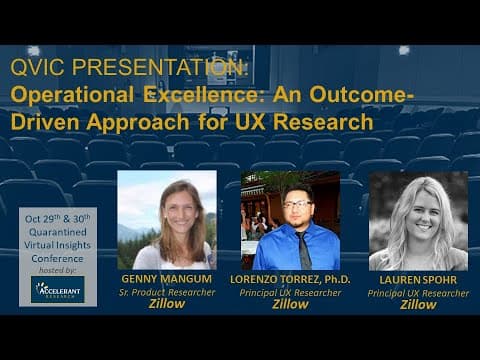 04
04Operational Excellence and an Outcome-Driven Approach for UX Research
Researchers from Zillow Group's centralized UX research team describe how they adapted their product-side outcome framework to define and pursue operational excellence for their own discipline. The talk covers the full framework they built, covering six phases of the research process and a set of cross-cutting enablers, then walks through three concrete applications: measuring research quality, building a candidate interview question bank, and assessing team skills. The session closes with lessons learned and a vision for expanding the framework across Zillow's other research disciplines.
Watch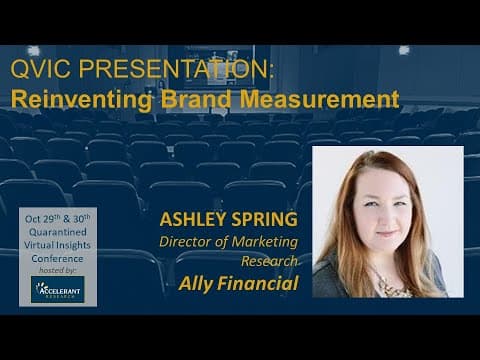 05
05Reinventing Brand Measurement: A Seven-Year Journey at Ally Financial
Ashley Spring, Director of Marketing Research at Ally Financial, walks through a seven-year evolution of brand measurement at Ally, from two costly, siloed surveys in 2013 to a six-vendor ecosystem that cuts spend in half while delivering richer, more actionable insights. The talk covers each phase of change, the rationale behind each decision, and the principles that guided what to keep, test, or discard. The core argument is that reinventing brand measurement is a gradual, iterative process tied closely to business strategy, not a single methodological overhaul.
Watch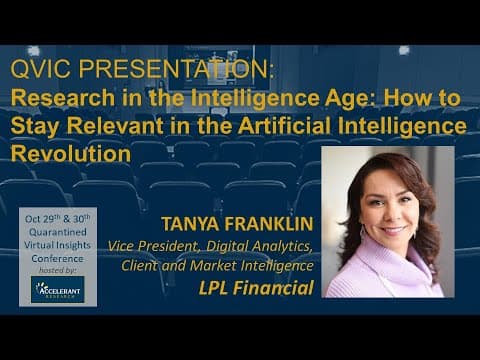 06
06Research in the Intelligence Age: Staying Relevant in the AI Revolution
Tanya Franklin, VP of Digital Analytics, Client and Market Intelligence at LPL Financial, traces the arc of AI development from Charles Babbage to neural networks and argues that consumer and market research is not threatened by AI but must actively integrate with it. She presents two complementary strategies: embedding AI tools within the insights function to accelerate insight generation, and using traditional research methods to guide, pressure-test, and refine AI and machine learning solutions. The talk closes with a call for human intelligence, including diverse perspectives, to remain central to any data strategy.
Watch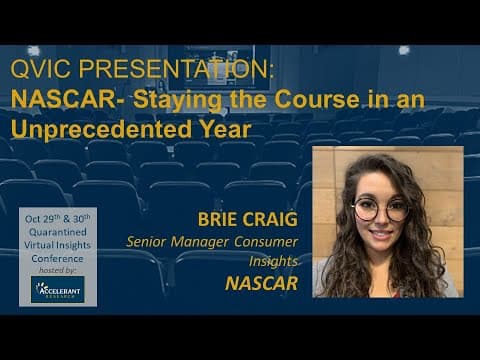 07
07Staying the Course: How NASCAR's Consumer Insights Team Navigated an Unprecedented Year
Bree Craig, Senior Manager of Consumer Insights at NASCAR, walks through how her internal research team scrapped its 2020 plan and rebuilt it around four priorities: fan interest, attendance readiness, engagement, and partner value. She covers the research strategy behind NASCAR's esports pivot, its return as the first major sport back on track, and the data that informed the organization's decision to ban the Confederate flag and support Bubba Wallace's advocacy.
Watch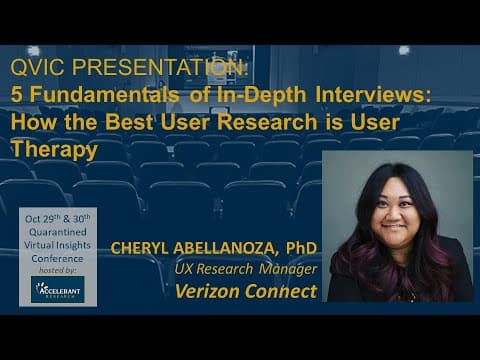 08
08The Five Fundamentals of In-Depth Interviews: How the Best User Research Is User Therapy
Dr. Cheryl Abelinosa, UX Research Manager at Verizon Connect, argues that clinical psychology and therapeutic interviewing skills are the most transferable and underappreciated foundation for conducting great user research. Drawing on her background in clinical counseling and cognitive neuroscience, she walks through real interview examples that show how therapeutic frameworks surface richer insights, and presents five fundamentals for running effective in-depth interviews. The talk closes with a parallel between the core conditions of successful therapy (rapport, unconditional positive regard, and therapeutic alliance) and the conditions for successful user research.
Watch 09
09Tracking Consumers Through COVID-19: How Wolverine Worldwide Mobilized a Seven-Month Insights Tracker
Ora Nelson, Senior Manager of Consumer Insights at Wolverine Worldwide, describes how her team built and ran a longitudinal consumer tracker starting one week into the U.S. pandemic shutdown in March 2020. Using the dscout diary platform, the team followed 100 general-population consumers and later added targeted segments, running nine waves of research over seven months to capture how sentiment and behavior shifted across distinct phases. The talk covers what consumers felt, did, and needed from brands at each stage, and how Wolverine's portfolio brands responded in real time.
WatchWant to be in the room next time?
Register for next conferenceRelated conferences
August 2020 ARVIC
The August 2020 ARVIC conference examined how research and innovation teams can deliver sharper, more actionable insights by prioritizing quality, adaptability, and practical execution over scale and convention.
ViewFebruary 18, 2021February 2021 ARVIC
The February 2021 ARVIC conference centered on the human and organizational skills that make research matter, arguing that empathy, political awareness, and collaboration are as important as methodology.
ViewMarch 25, 2021March 2021 ARVIC
The March 2021 ARVIC brought together practitioners across CX research, ethnography, retail, and survey methodology to make the case for faster, more credible, and more operationally grounded insights work.
ViewPresent at the next ARVIC
Share a method, a study, or a hard-won lesson with a room of senior research practitioners.