

April 2020 ARVIC
The April 2020 ARVIC conference examined how COVID-19 was reshaping research practice, consumer behavior, and organizational decision-making, while surfacing enduring principles around rigor, ethics, and influence.
- 01Behavioral Economics for Marketing and Consumer Research
- 02Building a Culture for Policy Within UX Research
- 03Data Privacy in a Pandemic: What COVID-19 Means for Personal Data Collection and the Research Industry
- 04Debunking A/B Testing Best Practices
- 05From Insights Platform to Implementation: A Personas Case Study with Caesarstone
- 06Influencing with Insights: Getting People to Act
- 07Navigating Sudden Unemployment as a UX Researcher: One Senior Researcher's Journey Through COVID-19
- 08Rapport at a Distance: Getting Into the Groove With Your Interviewee
- 09Real-Time Media Insights in the Age of COVID-19
- 10Remote Research Using Distributed Neuroscience
- 11The DIY vs. Do-It-For-Me Framework for Outsourcing Market Research
- 12Transforming the Pet Care Category Through Shopper Based Design
- 13Transitioning from Office to Working from Home: Lessons from Remote-First Companies
- 14UX Research Strategies for Success in Highly Regulated Industries
- 15Why We Hoard Toilet Paper: Using Insider Insight to Study Crisis Consumer Behavior
The April 2020 ARVIC virtual conference convened insights and product professionals at the sharpest inflection point of the early pandemic. Talks ranged from toilet paper hoarding studies and real-time media tracking to behavioral economics, neuroscience wearables, and research policy at scale. Beneath the variety, three concerns ran through nearly every session: how to keep research credible under pressure, how to translate findings into decisions, and how organizations should adapt their tools and processes when the ground shifts fast.
COVID-19 as a Pressure Test for Research Practice
Several talks used the pandemic as a live case study for what good research practice looks like under stress. A qualitative study on toilet paper hoarding demonstrated that fast, conversation-based discovery methods can surface emotional drivers, comfort-seeking, fear of social exclusion, and desire for control, that structured surveys miss entirely. A real-time media insights session showed that consumer behavior shifted in days, not weeks, and that teams with existing processes and data relationships were able to reprioritize quickly while others hesitated. A shopper insights talk made the straightforward recommendation to pause standard behavioral research during periods of abnormal consumer behavior, because pantry-loading dynamics make the data non-comparable to baselines.
- Fast, light-touch discovery methods are well suited to pre-discovery phases when you do not yet know what questions to ask.
- Reprioritization requires relationships and processes already in place, not improvised ones built during a crisis.
- Know when not to field. Behavioral data collected during abnormal periods can mislead more than it informs.
Rigor, Bias, and the Limits of What Data Can Tell You
A recurring theme across methodologically focused talks was the gap between what research outputs appear to say and what they can reliably support. A session on A/B testing argued that experimental statistics describe the past only and that treating two-week results as predictive of long-term outcomes leads to bad product decisions. A behavioral economics session demonstrated live, using audience experiments, how anchoring, decoy effects, and loss aversion systematically distort survey responses. A neuroscience talk showed that self-reported liking predicts actual behavior only 15 to 30 percent of the time, while neurological immersion measures consistently outperform it.
- Audit question order and numeric context in surveys for unintended anchoring before fielding.
- Reframe A/B experimentation as a quality gate and risk-reduction mechanism rather than a revenue forecasting tool.
- Most survey designs evoke deliberate, effortful thinking; most purchase decisions do not. Closing that gap is a design problem, not just an analysis problem.
Translating Findings into Decisions
Multiple talks addressed the persistent problem of research that is methodologically sound but organizationally inert. An analytics leader from a major consumer goods company presented a practical blueprint: know your audience before you build your content, name the opportunity cost explicitly, tell a specific consumer story rather than leading with aggregates, and make the path to yes visibly low-risk. A personas case study showed how consolidating prior research into a shared foundation before fielding, and involving creative and commercial teams early, produced segments that were immediately actionable across social, retail, and web strategy.
- The most durable influence is guiding decision-makers to a conclusion they feel they reached themselves.
- Aggregate data alone rarely moves a room. A named individual with real challenges gives leaders something concrete to empathize with.
- Major decisions often require the same message delivered multiple times and in different contexts before it lands. Timing is a real variable.
Ethics, Privacy, and Policy as Operating Conditions
Three talks treated privacy and policy not as compliance checklists but as active design considerations. A data privacy session argued that the pandemic had accelerated personal data collection to an all-time high and that the research industry must recommit to privacy-by-design principles before regulators eliminate traditional professional exemptions. A talk on research policy at a large technology company showed that framing policy as an enabler rather than a blocker, and embedding it into every phase of the research lifecycle, produces more consistent compliance than treating it as a separate step. A UX research session covering regulated industries made the case that identifying legal and organizational constraints before starting a project, not after, shapes better and faster research plans.
- Seventy percent of people are more likely to share data when collectors clearly explain why it is needed and how it will be used.
- Brands that buy research have a role to play: preferring suppliers that subscribe to a recognized code of ethics reinforces good practice across the industry.
- In regulated environments, documentation is both a legal shield and a working discipline. Audits are real, and the cost of non-compliance is concrete.
Remote Work, Remote Research, and What Sticks
Talks on remote work and remote qualitative methods shared a common argument: the shift was already underway, COVID-19 simply accelerated it, and the habits formed now are likely to persist. Practical guidance covered dedicated physical workspace, synchronous versus asynchronous tool selection, and the deliberate manufacture of human connection in distributed teams. On the research side, a senior design researcher at an automotive company shared rapport-building protocols for remote interviews and noted that online settings make it easier for participants to discuss sensitive topics and give candid negative feedback, a feature, not a limitation. Video highlights and testimonials in deliverables were identified as an emerging expectation that will outlast the crisis.
- Set up a dedicated physical workspace before solving for tools or meeting schedules.
- Distinguish synchronous from asynchronous work and match the right tool to each type. Using one tool for everything recreates the interruption patterns of an open office.
- Remote interview formats lower the barrier for participants to share sensitive or negative feedback. Design for that, rather than trying to replicate in-person conditions exactly.
Organizational Structure and the Outsourcing Question
Two talks addressed how insights teams should structure their work and partnerships. A framework from an insurance company mapped four project factors, business decision scale, methodology complexity, available tools, and recruit difficulty, onto a simple matrix to guide the DIY versus outsourcing choice. The consistent recommendation was to let the business decision drive the methodology and the sourcing choice, not budget pressure or available tools. A separate talk on UX research in regulated industries reinforced this: vendors are subject to the same regulatory requirements as in-house teams and must be vetted accordingly.
- Simple decision, simple methodology: strong DIY candidate. Complex decision, complex methodology: bring in a full-service partner.
- Hybrid approaches are common and valid. Moderating in-house while outsourcing recruit, or using a vendor tool for programming while handling analysis internally, are both reasonable configurations.
- When evaluating strategic research partners, prioritize transparency, full-service capability across qual and quant, and a willingness to set realistic expectations.
Presentations
 01
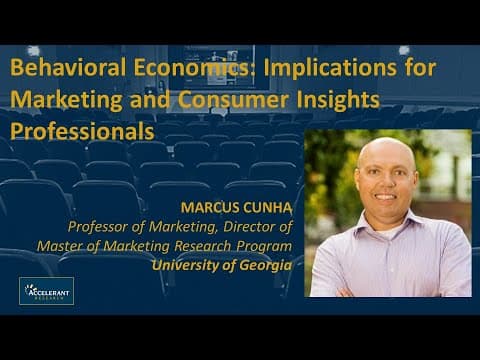
01Behavioral Economics for Marketing and Consumer Research
Marcus Cunha, Director of the MMR Program at the University of Georgia, presents behavioral economics as a practical lens for understanding how consumers actually make decisions, contrasting it with classical rational-choice theory. Drawing on live survey experiments run with conference attendees, he demonstrates how anchoring, decoy effects, range-frequency perception, loss aversion, and hedonic editing can systematically shift responses, and argues that market research design must account for these effects to avoid misleading results. The session closes with a Q&A covering outlier handling, decoy calibration, COVID-19 effects on decision processing, and the ethics of applying behavioral nudges.
Watch the talk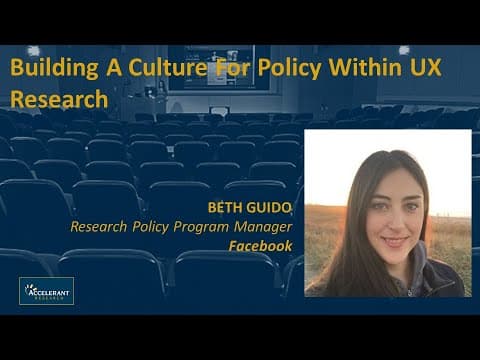 02
02Building a Culture for Policy Within UX Research
Beth Guido, Research Policy Program Manager at Facebook, closes the April 2020 ARVIC quarantine virtual insights conference with a lightning talk on how to embed research policy into every phase of the research lifecycle. She outlines the four pillars of Facebook's research policy program, explains why policy compliance matters for users and organizations alike, and argues that the right framing, infrastructure, and cross-functional relationships make policy an enabler of great research rather than a blocker.
Watch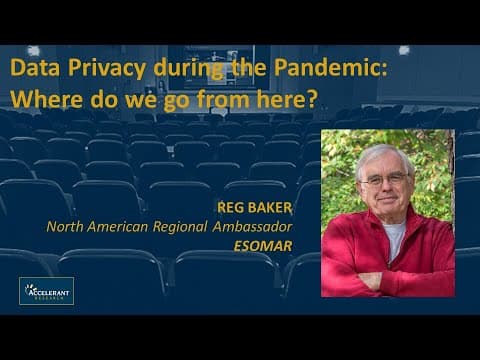 03
03Data Privacy in a Pandemic: What COVID-19 Means for Personal Data Collection and the Research Industry
Reg Baker, North American Regional Ambassador at ESOMAR, argues that the COVID-19 pandemic has dramatically accelerated both the volume of personal data being collected and the scope of its use, far beyond typical advertising and marketing purposes. Drawing on Pew Research data, Shoshana Zuboff's work on surveillance capitalism, and ESOMAR's own research, Baker makes the case that the market research industry must recommit to privacy-by-design principles and self-regulation before regulators close the window on the profession's traditional exemptions. The talk closes with four concrete actions the industry should take to distinguish itself from advertisers and protect the individuals whose data it relies on.
Watch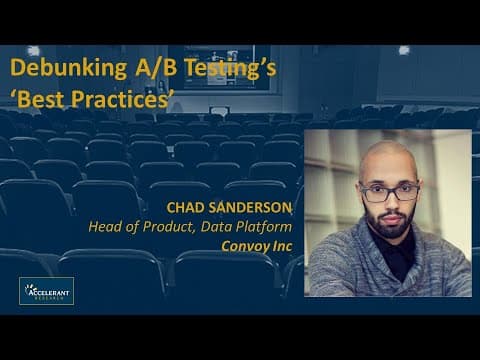 04
04Debunking A/B Testing Best Practices
Chad Sanderson, Head of Product for the Data Platform at Convoy, challenges commonly accepted A/B testing best practices, particularly the two-week experiment threshold and the use of short-term metrics as predictive signals. He argues that experimental statistics are descriptive of the past only, and that treating them as predictive leads to bad product decisions and poor user experiences. He closes with a practical reframe: use experimentation primarily as a quality gate and insurance mechanism rather than a revenue forecasting tool.
Watch 05
05From Insights Platform to Implementation: A Personas Case Study with Caesarstone
Luke Williams, Senior Research Director at Accelerant Research, and Courtney Babbitt, Market Research Manager at Caesarstone, walk through the end-to-end process of a high-impact personas study designed to support Caesarstone's shift from a pure push/B2B strategy to direct-to-consumer marketing. The talk covers the structured groundwork that preceded fielding, the analytical approach used to identify four actionable segments, and the concrete ways Caesarstone has since applied the findings across social media, media partnerships, retail distribution, and a new consumer website.
Watch 06
06Influencing with Insights: Getting People to Act
Naja Hendricks, an analytics and insights leader at Procter & Gamble, walks through a practical blueprint for turning research findings into decisions. She covers how to align recommendations with business goals, craft compelling consumer stories, and remove friction so decision-makers can say yes. The talk draws on real P&G examples, including a low-income consumer immersion exercise and a long-running strategy that took years to land.
Watch 07
07Navigating Sudden Unemployment as a UX Researcher: One Senior Researcher's Journey Through COVID-19
Joel Barr, a senior UX researcher with seven years of experience in healthcare and home improvement retail, shares his personal experience losing his contract role at Lowe's Home Improvement on March 13, 2020, amid the early COVID-19 lockdowns. Drawing on his own job search and a LinkedIn following he built through transparent, empathy-driven posts, Joel offers practical advice on staying productive during unemployment, building a portfolio, and finding opportunities as both a new and experienced researcher. The session is conversational and Q&A-heavy, with Joel answering audience questions in real time.
Watch 08
08Rapport at a Distance: Getting Into the Groove With Your Interviewee
Jenny Collins, Senior Design Researcher at Ford Motor Company, shares practical techniques for building genuine rapport during remote qualitative interviews and online chats. Drawing on her background as an anthropologist, she walks through preparation, opening protocols, and in-interview behaviors that compensate for the absence of shared physical space. The session closes with open discussion on COVID-19's likely long-term effect on research methodology, including automotive-specific challenges around in-person testing.
Watch 09
09Real-Time Media Insights in the Age of COVID-19
Tom Somers, VP of Audience Intelligence and Development at Tegna, shares how a major local TV group used real-time data sources, including Nielsen/comScore ratings, digital platform metrics, social listening, and in-market consumer panels, to track rapidly shifting audience behavior during the early weeks of the COVID-19 pandemic. He draws lessons from those shifts for insights and research teams across industries, emphasizing quick reprioritization, team diversity, and staying close to actual consumer needs rather than assumed ones. The talk is grounded in Tegna's footprint of 62 TV stations across 51 markets, which gave the team a natural laboratory for comparing how different markets responded at different speeds.
Watch 10
10Remote Research Using Distributed Neuroscience
Dr. Paul Zak, founder of Immersion Neuroscience, presented how wearable sensors and cloud-based algorithms can measure neurological engagement, which he calls "immersion," in real time and at a distance. He demonstrated that immersion, a composite signal inferred from peripheral nervous system data, outperforms self-reported liking as a predictor of purchase, recall, donations, and other behavioral outcomes. The session included live examples from Super Bowl ad analysis, music streaming prediction, and two recent studies on what audiences want to watch and how brands should communicate during the COVID-19 pandemic.
Watch 11
11The DIY vs. Do-It-For-Me Framework for Outsourcing Market Research
Susan Lawson, from the market research and insights team at Allstate, presents a practical framework for deciding when to conduct research in-house versus outsourcing to a vendor partner. The framework centers on four factors, business decision, methodology, tools, and recruit, mapped onto a 2x2 matrix of decision complexity versus methodology complexity. The talk was delivered at the April 2020 ARVIC virtual conference.
Watch 12
12Transforming the Pet Care Category Through Shopper Based Design
Karen Lee, Shopper Insights lead for cat main meal at Mars Petcare, walks through the company's proprietary Shopper Based Design process, explaining how proposition-based shelf organization drives premiumization and category growth for both retailers and Mars. The talk covers how cat shopper decision criteria have evolved, how five core category propositions were identified through qualitative and quantitative research, and how those propositions are tested in a dedicated shopper lab and validated through in-market audits. A Q&A addresses how COVID-19 is affecting both cat food sales and the appropriateness of running shopper research during the pandemic.
Watch 13
13Transitioning from Office to Working from Home: Lessons from Remote-First Companies
Jayden Brazil, host of the Happy Market Research Podcast, draws on a special-edition podcast series to share practical guidance for market researchers and insights professionals suddenly working from home. He interviewed three guests, including leaders from Wildbit, Lookback, and Delve, to compare remote-native companies with those forced into rapid transition. The talk covers physical setup, tool selection, organizational transparency, and the human connection habits that remote work requires.
Watch 14
14UX Research Strategies for Success in Highly Regulated Industries
Chrissy, VP of Usability, User Research, and Accessibility at Regions Bank, draws on three decades of UX research experience to share five practical strategies for conducting effective user research inside heavily regulated organizations. She argues that constraints are not roadblocks but boundaries that, when understood early, enable more creative and compliant research practices. The talk is relevant to any researcher navigating organizational complexity, not only those in regulated industries.
Watch 15
15Why We Hoard Toilet Paper: Using Insider Insight to Study Crisis Consumer Behavior
Mona, founder of Motivate Design, presents a qualitative study on toilet paper hoarding during the early weeks of COVID-19. She uses the study as a practical demonstration of "Insider Insight," a fast, conversation-based discovery method her firm developed as an alternative to traditional interviews and focus groups. The talk covers the method's origins, how five real conversations revealed emotional and social drivers behind hoarding, and where Insider Insight fits within a broader research process.
WatchWant to be in the room next time?
Register for next conferenceRelated conferences
May 2020 ARVIC
The May 2020 ARVIC conference brought together insights, marketing, and product leaders to explore how COVID-19 was reshaping consumer behavior, research methods, and business strategy across categories.
ViewAugust 28, 2020August 2020 ARVIC
The August 2020 ARVIC conference examined how research and innovation teams can deliver sharper, more actionable insights by prioritizing quality, adaptability, and practical execution over scale and convention.
ViewOctober 29, 2020October 2020 ARVIC
The October 2020 ARVIC conference brought together insights practitioners to share how rigorous research operations, adaptive tracking, and strategic integration with emerging technology keep the discipline indispensable in a rapidly changing environment.
ViewPresent at the next ARVIC
Share a method, a study, or a hard-won lesson with a room of senior research practitioners.