

February 2026 ARVIC
The February 2026 ARVIC conference explored how research teams can stay resilient and effective by connecting experience disciplines, integrating AI thoughtfully, and building creative partnerships that expand capacity without expanding budgets.
- 01AI-Driven Member Sentiment and Experience Insights: How Experian Consumer Services Elevated Understanding of Member Feedback
- 02Gen Z Coffee Segmentation: Five Consumer Profiles and Business Implications
- 03Internal and External Listening in the Age of AI
- 04Outsourcing Innovation: Building an Industry-Academic Mentorship Collaboration
- 05Reimagining the Future: How Insights Can Make AI Better (and Vice Versa)
- 06Who X: UX, CX, EX, What's Next? Personal Notes on Experience Maxing
Across three talks, February 2026 ARVIC returned to a single underlying question: how do research and experience teams grow their impact when resources are tight, technology is shifting fast, and organizational complexity keeps rising? Speakers from Verizon Connect and Indeed brought practitioner-level answers grounded in real programs, real failures, and real guardrails.
Experience as a Connected Maturation Path, Not a Set of Silos
One talk reframed UX, CX, and EX not as competing disciplines but as successive expansions of the same human-centered practice. As research matures inside an organization, its scope naturally widens from product features to the full customer journey to the internal employee experience that drives it. Conway's law sits at the center of this argument: the way a team communicates and operates internally shows up directly in what customers experience externally, making EX a lever for CX quality, not a separate concern.
- Translating research findings into business language (dollars saved, time saved, process adoption) is more persuasive than presenting insights in research terms when advocating for headcount or resources.
- Adaptability and authenticity are more durable career assets than any specific title, method, or tool, including AI.
- A 'post-identity' mindset anchored in curiosity and core skills makes practitioners more resilient to AI adoption and organizational restructuring.
AI as Augmentation: Scaling Listening Without Losing Rigor
Two speakers from Indeed detailed how AI and large language models are being used to scale both employee and customer listening programs. The core argument was precise: AI solves a capacity problem in analysis, not a data collection problem. But that framing came with serious technical caveats that the team has built explicit guardrails around.
- LLMs hallucinate numbers, collapse nuance, drift across runs, and can surface PII. Statistical validation must happen outside the model, and analysts must review all output before it reaches leadership.
- Practical guardrails include masking PII before sending data to an LLM, maintaining minimum sample sizes, running prompts multiple times to check consistency, and maintaining a prompt bank to track drift.
- External listening is shifting from siloed channel-by-channel reports to consolidated multi-source stories that combine surveys, unstructured social data, and call recordings.
- Synthetic audiences and AI-moderated tools are emerging but should always be supplemented with live qualitative data. A hybrid human-plus-AI approach is the current best practice.
- AI will not replace listening professionals. Teams that succeed use it for targeted augmentation, not as a wholesale replacement for human judgment, context, and legal awareness.
Expanding Capacity Through Industry-Academic Collaboration
A third talk offered a practical model for teams that need foundational research but lack the budget or headcount to commission it internally. Drawing on two years of partnering with a Georgia Tech graduate course, a Verizon Connect researcher outlined a four-stage framework covering pitch, prep, management, and output. The collaboration delivers real research at zero capital cost while giving graduate students genuine industry exposure.
- A three-tier mentorship structure, with embedded mentors, subject matter mentors, and project operations support, keeps time commitments manageable for industry participants.
- Backend operations, including communication tools, participant recruitment access, and shared document storage, must be ready before students arrive.
- Mentors should guide rather than rewrite: the learning that comes from student mistakes is a core part of the program's value.
- Preserving student artifacts in a research repository extends the impact of the work for years, allowing future internal teams to build on student findings.
- End-of-semester retrospectives with both students and mentors surface the most actionable process improvements.
The Through-Line
Whether the topic was experience strategy, AI integration, or academic partnership, every talk at ARVIC February 2026 circled back to the same practical concern: how do skilled researchers protect rigor and human judgment while doing more with less? The answers were structural, not inspirational, offering replicable frameworks that teams can adapt regardless of their size or tech stack.
Presentations
 01
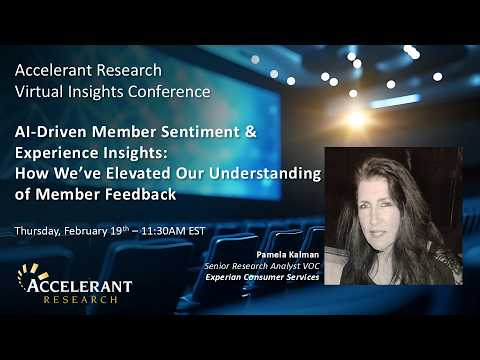
01AI-Driven Member Sentiment and Experience Insights: How Experian Consumer Services Elevated Understanding of Member Feedback
Pamela Calman, Senior Research Analyst at Experian Consumer Services, walked through a three-phase evolution from manual comment coding to AI-powered cross-survey sentiment analysis. She described how two tools, XM Discover and Theydo, now allow her team to connect member feedback across all channels, identify systemic issues faster, and surface real-time emotional drivers tied to quantitative metrics. The talk emphasized that AI enhances rather than replaces rigorous human review of raw data.
Watch the talk 02
02Gen Z Coffee Segmentation: Five Consumer Profiles and Business Implications
A team of Master of Marketing Research students from the University of Georgia presented findings from a segmentation study on Gen Z coffee consumption habits. Using a survey of 400 participants aged 18 to 28, they applied factor analysis and cluster analysis to identify five distinct consumer segments. The presentation covered consumption patterns, attitudinal dimensions, segment personas, and targeted messaging strategies for coffee brands.
Watch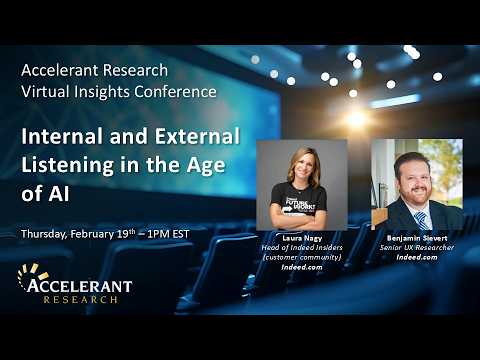 03
03Internal and External Listening in the Age of AI
Ben and Laura from Indeed share how their teams use AI and large language models to scale employee and customer listening programs. Ben covers the technical risks of LLM-based analysis and the guardrails needed to protect data integrity, while Laura describes how AI is accelerating external listening, breaking down silos, and enabling faster customer insights. Both emphasize that AI augments skilled analysts rather than replacing them, and that a hybrid human-plus-AI approach is essential.
Watch 04
04Outsourcing Innovation: Building an Industry-Academic Mentorship Collaboration
Stephanie, a UX researcher at Verizon Connect, shares a framework for partnering with a university graduate course to give students real industry experience while generating foundational research for the business at no capital cost. Drawing on two years of running a collaboration with Georgia Tech's Foundational Research Methods course, she walks through a four-stage process: pitch, prep, management, and output. The talk is aimed at researchers and teams who want to expand mentorship opportunities in a market where internships and junior hiring have shrunk.
Watch 05
05Reimagining the Future: How Insights Can Make AI Better (and Vice Versa)
Pavey Gupta presents a three-chapter framework for rethinking how market insights and AI relate to each other, arguing that most AI deployments in insights fail because they start with technology rather than business problems. He introduces the MOA algorithm and an "infinity growth loop" concept to show how human curiosity, empathy, and pattern-recognition can make AI more effective, while AI in turn scales and accelerates the work of insights teams.
Watch 06
06Who X: UX, CX, EX, What's Next? Personal Notes on Experience Maxing
Cherylyn, Associate Director of UX Research at Verizon Connect, traces the maturation of experience design from UX through CX and EX, arguing that each discipline builds on the last and that the connections between them are inseparable. She draws on Niels' UX research maturity model, Conway's law, and her own career journey to show how adaptability, authenticity, and human-centered thinking remain the durable core of the field regardless of technological shifts. The talk closes with a practical Q&A on advocating for research resources and translating insights into business language.
WatchWant to be in the room next time?
Register for next conferenceRelated conferences
March 2026 ARVIC
The March 2026 ARVIC conference examined how AI is reshaping research and design practice, pressing the field to sharpen human judgment, defend data quality, and bridge disciplines before standards catch up.
ViewApril 23, 2026April 2026 ARVIC
The April 2026 ARVIC conference challenged insights professionals to move beyond generating reports and toward driving decisions, cultural change, and lasting organizational impact.
ViewOctober 30, 2025October 2025 ARVIC
The October 2025 ARVIC conference brought together researchers to explore richer, more human-centered approaches to understanding people, from embodied listening techniques to frameworks that surface what participants cannot easily articulate.
ViewPresent at the next ARVIC
Share a method, a study, or a hard-won lesson with a room of senior research practitioners.