

October 2025 ARVIC
The October 2025 ARVIC conference brought together researchers to explore richer, more human-centered approaches to understanding people, from embodied listening techniques to frameworks that surface what participants cannot easily articulate.
The October 2025 ARVIC conference centered on a shared challenge: how do researchers go beyond surface-level data to understand people more fully and communicate those insights in ways that move stakeholders to action? The single talk in this hub draws on ethnomusicology and retail research to argue that the answer starts with how researchers listen.
Rethinking Listening as an Active, Multi-Sensory Practice
A core provocation of the conference is that listening is not passive reception. Drawing on experience in both music and UX research, one talk makes the case that genuine listening combines auditory, tactile, and contextual awareness. Researchers who treat listening as simply transcribing what is said miss the majority of what an experience actually contains.
Surfacing What Participants Do Not Say
Ethnographic listening is presented as a method for excavating the assumed, the commonplace, and the indescribable alongside the remarkable. The RACE framework (Remarkable, Assumed, Commonplace, Indescribable) gives researchers a practical four-category structure for capturing and communicating the full depth of a user or customer experience, including everything participants take for granted or struggle to put into words.
Communicating Findings to Stakeholders
Knowing what you found is only half the job. The conference highlights two principles for closing the gap between insight and action:
- Make the unfamiliar feel familiar and the familiar feel unfamiliar, calibrating explanations to what different stakeholders already know.
- Use immersive participation, such as bringing digital and product teams into a physical store to role-play as customers, to convey experiences that are hard to quantify in a report.
- Translate singular, intimate experiences into forms of meaning that stakeholders can understand and act on, always communicating findings with compassion for the people behind the data.
Presentations
 01
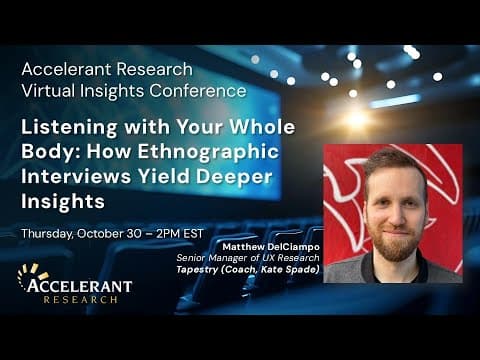
01Listening With Your Whole Body: How Ethnographic Interviews Yield Deeper Insights
Matt, a UX researcher at Tapestry (parent company of Coach and Kate Spade) with a background in ethnomusicology, argues that listening is not a passive act but a multi-sensory practice. He introduces a framework called ethnographic listening, organized around four categories of experience, and illustrates it with three research examples from retail and e-commerce contexts. The talk aims to help researchers understand people more completely, define experiences more intuitively, and communicate findings more compassionately.
Watch the talkWant to be in the room next time?
Register for next conferenceRelated conferences
August 2025 ARVIC
The August 2025 ARVIC conference explored how market research careers, methods, and client relationships are evolving across generations and in the age of AI.
ViewJuly 31, 2025July 2025 ARVIC
Accelerant Research was proud to present a webinar on Thursday, July 31st titled "Unconventional Career Paths into Research" featuring Susan Shaw, Customer Research Lead at Ford.
ViewFebruary 19, 2026February 2026 ARVIC
The February 2026 ARVIC conference explored how research teams can stay resilient and effective by connecting experience disciplines, integrating AI thoughtfully, and building creative partnerships that expand capacity without expanding budgets.
ViewPresent at the next ARVIC
Share a method, a study, or a hard-won lesson with a room of senior research practitioners.